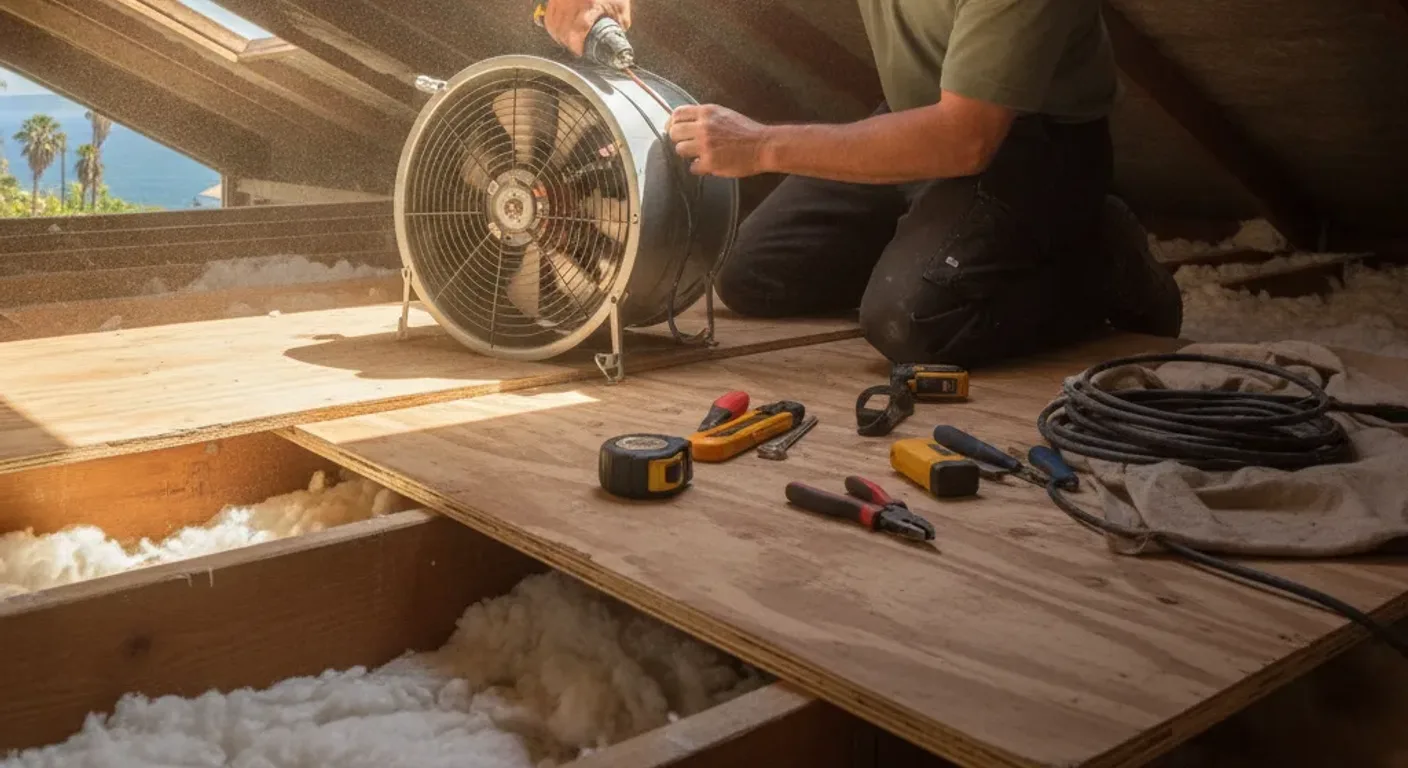
Attic conditions and ventilation must be evaluated at the property. Climate zone or neighborhood alone does not establish that a powered attic fan is appropriate.
Why attic heat is a bigger problem inland than on the coast
The San Diego coast stays in the mid-70s most of the year. Move ten miles inland and that picture changes fast. El Cajon routinely hits 95–100°F in July. Escondido and Santee aren’t far behind. Those temperatures outside translate to attic temps of 130°F or higher, even in a well-built home.
The problem is radiant heat transfer. Your attic floor is essentially a ceiling-wide hot plate sitting directly above your living space. Insulation slows the transfer but doesn’t stop it. The fix is ventilation: move that hot air out before it has a chance to dump into the house below.
A properly sized attic fan can drop attic temps by 30–50°F, which noticeably reduces the load on your AC and cuts SDG&E bills during the hottest months. In older homes without AC, particularly the postwar ranch houses common in El Cajon and Santee, it can make the difference between tolerable and miserable.
Attic fans vs whole-house fans: these are different things
People use both terms and mean different things. Here’s the distinction.
An attic exhaust fan (what this post is about) sits in the attic and pulls hot air out through the roof or a gable vent. It works within the attic space only. Your living area stays sealed off. The fan runs on a thermostat, kicks on when the attic hits a set temperature, and exhausts that heat outside.
A whole-house fan is a different product that mounts in a ceiling or hallway and pulls cooler outside air through open windows and exhausts it through the attic. It conditions your living space directly. Whole-house fans require more planning around existing attic ventilation and are typically a larger installation job.
If someone quotes you on a “whole-house fan,” confirm which type they mean before agreeing to anything.
Fan types, best fit, and installed cost
Pricing depends on the product, access, mounting surface, existing connections, and any work the professional excludes from the quoted scope. Ask for a written quote after the pro reviews photos and product details.
The quote should state whether the fan is supplied, what roof or gable work is included, how power is handled, and which repairs are excluded.
Why solar attic fans make sense in San Diego
The main knock on solar attic fans is that they underperform on cloudy days. In most of the country, that’s a real limitation. The coast gets some marine layer in May and June, but inland communities like Poway and Escondido see a lot of sun during the hottest months, which is when the fan needs to run.
Solar fans also eliminate the need for a wiring run, which is often the most expensive part of a hardwired installation. If you have a good south-facing or west-facing roof slope, a solar unit is often the right call. Confirm current permit and electrician requirements for the proposed contract. Don’t guess those from this page.
For homes with a gable vent already in place, a solar gable fan is the cleanest install. The fan mounts into the existing opening, the solar panel attaches to the exterior wall or brackets outside, and no roof penetration is needed.
Gable-mount vs roof-mount: which do you have?
Gable vent: The triangular louvered vent at the peak of the end wall of your home, facing the street or the side yard. If you have one, it’s the easiest spot to put an attic fan. No roof penetration, no flashing required. The install is essentially removing the existing vent cover, fitting the fan, and securing it. For solar, you add a panel on the exterior.
Roof-mount: If your home has a hip roof (sloped on all four sides) or just doesn’t have gable vents, the fan goes on the roof. Flashing is required to seal around the penetration. On a shingle roof, this is straightforward. On a tile roof, it’s a different job. Lifting and relaying clay or concrete tiles without cracking them is a roofer’s skill. If you have tile roofing, bring in a roofer for any roof-mount fan that requires a new penetration.
When a handyman handles it vs when you need a different trade
A handyman is the right call for:
- Installing a solar attic fan (gable or roof-mount on a shingle roof) into an existing opening
- Replacing a dead attic fan with a like-for-like unit in the same location
- Installing a hardwired fan where an existing outlet or wired switch already exists in the attic
You need a licensed electrician when:
- There’s no existing circuit in the attic and you want a hardwired fan. Running a new circuit from your panel requires a licensed electrician and typically a permit.
- The wiring in the attic is old or deteriorated. Connecting to degraded wiring is a fire risk, not a handyman call.
You need a licensed roofer when:
- You have tile roofing and the installation requires a new penetration. Tile roofs are not forgiving of mistakes. Cracked tiles mean leaks.
- The existing roof vent or gable vent is damaged and needs structural repair before the fan can be mounted.
The independent pro should be straight about scope. If they open a job and find it needs a different trade, they should tell you before starting.
Internal links worth reading before you decide
If your attic access situation is unclear, the attic ladder installation guide covers what’s involved in getting safe attic access first. That’s worth reading before any attic work.
For a broader summer readiness checklist, the summer home prep guide for San Diego covers attic fans alongside other heat-season priorities.
For other repair and installation requests across San Diego County, see the general repairs service page.
Frequently asked questions
How much does attic fan installation cost in San Diego?
The quote depends on the selected fan, gable or roof work, access, power, controls, weather sealing, and repairs. Ask the professional to separate every item in writing.
Are solar attic fans worth it in San Diego?
For most inland San Diego homes, solar can be a practical option when the roof gets sun during the hottest part of the day. Solar fans run when the sun is on them, which is often when attic temps peak. They also avoid running new wiring, which can be the most expensive part of a hardwired installation. Confirm the product’s listed output against the attic volume.
Can an attic fan work if I don’t have AC?
It can help significantly. An attic fan removes heat from the attic before it radiates into your living space. It won’t cool your home the way AC does, but it reduces heat gain through the ceiling, which makes any cooling method more effective and makes uncooled spaces more tolerable during the hottest parts of the day. In older El Cajon and Santee homes built without AC, it’s one of the most practical improvements available.
Do I need a permit for attic fan installation in San Diego?
Confirm current permit rules with the authority serving the address. A solar attic fan replacing an existing vent may be treated differently from a hardwired fan that needs a new electrical circuit. Hardwired electrical work typically belongs with a licensed electrician. Don’t guess from this page.
What size attic fan do I need?
Attic fans are rated in CFM (cubic feet per minute). Use the fan manufacturer’s sizing method for the attic volume and climate. Do not treat a generic square-footage shortcut as the rating for your roof.
How long does attic fan installation take?
Time depends on access, roof type, whether the opening already exists, and whether new wiring is in scope. A hardwired job that needs a new circuit belongs with a licensed electrician, which changes the timeline.
If attic heat is the next job on the list, call (858) 400-4611 and we’ll match you with a local pro who can quote attic fan installation across San Diego County.
Would you rather hand this one to a pro than do it yourself? Call (858) 400-4611.
Request a quote