The boxes are in the garage on Felicita, or stacked in a second-floor condo off Centre City Parkway, and the mattress is already on the floor. The build stalls when a rail, slat pack, or hardware bag is still at the warehouse. A little prep before you book furniture assembly keeps the job honest: the right model, the right parts, and a path that actually fits the frame.
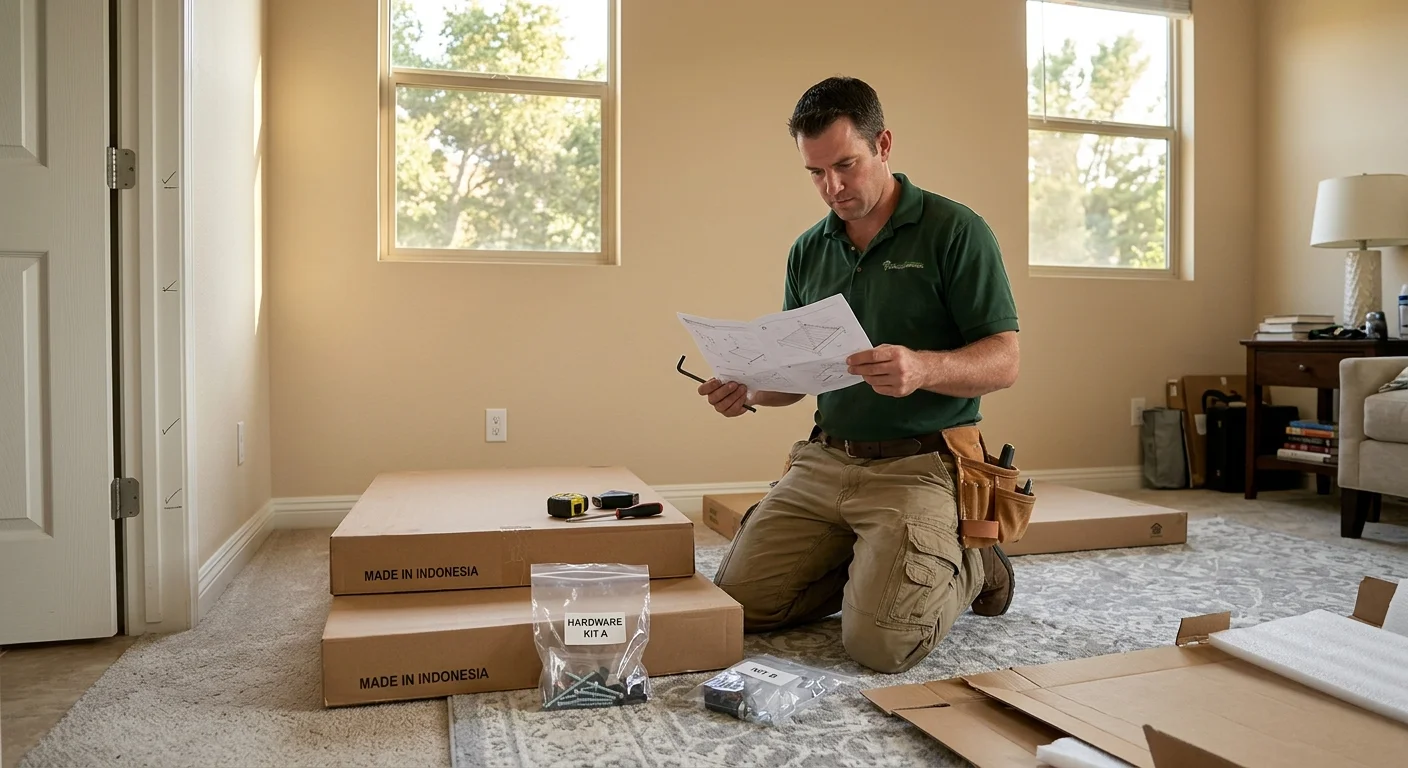
Confirm the frame model and all included boxes
A bed kit rarely arrives as one carton. Rails, a headboard, a footboard, slats, and a center beam often split across two or three boxes, sometimes on different days. Write the full model string from the packing slip, including size and finish code. Then walk the stack and match every carton number to that string.
Escondido deliveries split in real ways. A ranch house near Grand Avenue may take a single drop at the garage. A walk-up near Grape Day Park may leave cartons on a landing. A condo along Centre City Parkway may leave the long rail boxes in a lobby until you can move them. Photograph every shipping label: SKU, “1 of 3,” and any crushed corners.
If a carton is missing, stop. Do not mix leftover rails from an old frame with a new kit. Makers do not document that mix, so a pro should not guess a bolt pattern from memory. Color-matched wood from last year’s bed can still use a different hole layout.
Open only enough to confirm the long parts. You do not need a full dry-fit. You do need to see the center support, the legs or feet, and the slat roll. Slat packs hide under foam. Drawer fronts for a storage bed hide in a skinny box. Metal frames may include a separate headboard-bracket sleeve.
Note the bed size in writing: twin, full, queen, king, or California king. Do not assume the mattress on the floor matches the new frame. Measure the mattress length and width yourself and keep that note with the packing slip.
If you bought add-ons (under-bed drawers, a storage footboard, lighting), keep those boxes with the frame. A pro quoting flat pack assembly needs the full kit in one place. Split orders from two warehouses count as one job only when every carton is on site.
Inland North County heat is hard on particle board left on a garage slab. Bring cartons inside, off concrete, until the visit. Do not store panels against a west-facing wall for weeks. Label the room they belong in if you have more than one kit in the house.
People searching assemble furniture near me usually already have the cartons. The model check is how you prove the set is complete before anyone opens a hardware bag.
Match hardware bags to the product instructions
Hardware is where bed-frame jobs stall. Bags look identical. Cam locks, barrel nuts, and hex bolts mix on the first shake. Find the instruction booklet first. It is often taped to a rail or buried in carton 1.
Lay the bags on a table without opening every seal. Match bag letters or numbers to the parts list. If the list calls for bag A and bag C, and you only see one unlabeled pouch, photograph that pouch next to the list. Count visible bolts through the plastic when you can.
Do not dump every bag onto the carpet in a house with pets or kids. Escondido ranch homes with a slider to the yard lose small parts fast. Use a tray or a zip bag labeled with the model number.
Allen keys and barrel-nut drivers sometimes ship in a separate cardboard fold. Platform beds with wooden slats may include plastic caps and extra feet for a center support. Metal frames may include headboard brackets that only fit that brand’s own headboard. Do not assume a headboard from another line will bolt on. If the booklet does not show that join, it is not confirmed.
If a bag is missing, contact the retailer before the assembly visit. Bring the model number, the parts-list page, and photos. Hardware-store bolts are not a documented substitute unless the maker says they are. Thread pitch and head style matter more than the length you can see.
Keep the instructions with the boxes, not in a kitchen drawer. The pro needs the same sheet you used to count parts. If the booklet is only a QR code, screenshot the exploded diagram while you still have service. Reception can drop in older pockets of downtown Escondido and in some canyon-side tracts east of I-15.
If extra mystery parts arrive, do not throw them out. Photograph them next to the parts list. Some kits ship spare cams. Some ship a second set for an optional footboard. The booklet is the only source for which is which.
Measure doors, halls, stairs, and final placement
Measure the assembled footprint from the booklet: length, width, and height of the headboard. Then measure the path: front door, hallway turns, stair width, bedroom door, and the wall where the headboard will sit. Write the numbers on the same page as the model string.
Housing stock in Escondido is not one floor plan. Older homes west of Centre City Parkway, around downtown and toward Kit Carson Park, often have a tight turn at the hall and a modest bedroom door. Long king rails and a tall upholstered headboard may need to go in as parts and get built in the room. That is a planning note, not a delay. Tell the pro before the visit.
Two-story condos and townhomes along the I-15 corridor add stairs. Measure the stair width, the landing turn, and any handrail pinch. If the building uses an elevator, measure the cab opening and the door. Note whether the long boxes fit, not only the finished frame. Centre City Parkway complexes can require a loading zone or an elevator hold. Put that in the scope so the pro is not guessing from the street.
In the bedroom, tape the footprint on the floor. Leave room for nightstands, closet doors, and HVAC vents. Inland bedrooms on west walls take afternoon heat. Do not block a return-air grille with a platform base. If a ceiling fan hangs low over the bed, measure from floor to blade and compare that to the headboard height in the booklet.
Record ceiling height if the headboard is tall. Some storage beds need extra vertical room for lift hardware. Confirm that clearance in the maker’s sheet. Do not guess it from a photo of someone else’s room.
Parking matters for the drop-off more than for the build. Unloading long cartons on a busy stretch of Centre City Parkway is a different job than rolling them out of a cul-de-sac garage in east Escondido. Have the cartons inside, on the correct floor, before the assembly visit when you can. The pro is there to build the frame, not to hunt boxes in a hot garage.
This check is about this house, this stair, and this taped outline. A coastal condo with a different hall layout is a different path. Escondido prep lives in inland halls, I-15 stairs, and Centre City Parkway elevators.
Record mattress, base, and headboard details
Write down mattress size and type: innerspring, foam, hybrid, or an adjustable base. Measure the mattress yourself. Tags fade. Pillow-tops add height that a low platform may not show in a product photo.
A frame listed as queen is not confirmed to fit every queen mattress or every adjustable base. Only the manufacturer’s documentation can say that. If you do not have a spec sheet that names your mattress or base, give the pro the measurements and stop there. Do not ask anyone to declare a match that the booklet never makes.
If you have a separate box spring, bunkie board, or foundation, photograph the label. Some platform frames say not to use a box spring. Some metal frames require one. Read the booklet for this kit. A leftover foundation from the last apartment is not proof it belongs on the new rails.
Headboards come three ways: built into the kit, bolted to the rails with branded brackets, or a separate piece that stands behind the frame. If you want a headboard from another maker, you need that maker’s hardware notes. There is no universal bolt pattern. Do not treat “it looks like it will line up” as documentation.
Adjustable bases often sit on the floor inside a decorative surround, or they replace the slat deck. Do not assume the new frame’s slats and a motorized base can occupy the same space. Photograph the base model sticker and keep both instruction sets together. If the frame booklet is silent on adjustable bases, say so in the request. Silence is not approval.
If the room is a child’s room, treat bunk or loft kits as their own product. They ship with their own hardware and warning sheets. The U.S. Consumer Product Safety Commission advises following manufacturer instructions for furniture, including anchoring top-heavy pieces that are not meant to stand free. A bed frame is not automatically a tip-over case. A tall dresser next to it might be. Read the sheet that shipped with each piece.
Do not invent a weight rating or a “this mattress is fine” call. Occupant and load notes belong to the maker. Pass the booklet to the pro with the photos.
Photograph missing parts before requesting assembly
Before you request the build, take a complete photo set. Date it. Keep it with the packing slip.
Shoot every carton with the label readable. Shoot the long parts laid out so a missing rail is obvious. Shoot hardware bags next to the parts list. Shoot the instruction cover and the model number. Shoot the doorways and the taped floor outline. Shoot the mattress label and any base or headboard. Shoot damage, shortages, and extra mystery parts.
If you email a retailer for a missing cam lock, those images are the claim. A verbal “I think bag C never came” is weaker than a photo of the open carton and the list. Photograph broken parts in the carton with the packing material still around them. Then set that piece aside. A pro can plan around a delayed replacement only when the remaining parts are documented.
Do not start a partial build to see if it works. A half-started kit hides whether a part was missing from the start. It also mixes your fasteners with the factory bag, which makes a later shortage harder to prove.
For anyone booking after a move, this photo set is the whole job scope. Pair it with the notes on furniture assembly cost in San Diego so the quote matches the kit you actually have, the stairs you actually have, and the headboard you actually want attached. Fix Pro San Diego is a referral service. It matches you with an independent local pro. You contract and pay that pro directly.
If other work is on the same list (a wall-mounted light over the headboard, a dresser that needs anchoring, a door that no longer clears the new footboard), keep those items separate in the notes. Electrical work belongs with a qualified licensed electrician. Furniture anchoring follows the maker’s sheet and CPSC guidance. A bed-frame visit is the kit, the path, and the placement you already measured.
When to call us
Call when the cartons are on the right floor, the hardware is counted, and the mattress size is written down, or when a missing bag or a tight Escondido stair makes a DIY build a bad bet. An independent local pro can quote from your photos and build the kit that actually arrived. Call us at (858) 400-4611 and we’ll match you with a local pro who quotes the job before starting.
Would you rather hand this one to a pro than do it yourself? Call (858) 400-4611.
Request a quote