TL;DR, the short version:
- Complex DIY repairs (texture matching, tile, water-exposed work, load-bearing installs) fail far more often than simple single-step jobs
- A failed DIY repair usually costs more to correct than the job would have cost done right the first time, because a pro has to undo the failure before fixing the original problem
- The most-botched DIY categories are tile installation, drywall repair with texture matching, and door and window adjustment
- Visible amateur repairs hurt buyer confidence at sale and often trigger inspection-related price negotiations
Does DIY home repair actually save money?
The honest answer: sometimes yes, often no, and the gap between those outcomes is wider than most homeowners expect.
The appeal of DIY is real. Tools are more accessible than ever, YouTube tutorials are genuinely good, and a successful repair delivers both savings and satisfaction. The problem isn’t the concept, it’s the failure mode. When a DIY repair fails, you’re not just back to square one. You’re paying someone to fix what went wrong plus the original problem.
Here’s what actually decides whether DIY makes sense, and when it doesn’t.
Why complex repairs fail more often
Failure rates are not uniform across repair types. Simple single-step jobs (a coat of paint, a cabinet hinge, flat-pack furniture) rarely go badly wrong. The trouble starts with multi-step jobs that involve surface matching, anchoring, or water exposure, where one missed step shows up weeks or months later.
Moisture-exposed DIY repairs (bathrooms, exterior windows, decks) are the jobs most likely to need a professional redo. That is a failure-mode observation, not a Fix Pro field-log statistic. In a region like San Diego, where the marine layer adds a background humidity load that cycles through caulk and wood seals faster than inland climates, that failure window compresses.
The most-botched DIY jobs, and why they go wrong
Drywall repair with texture matching
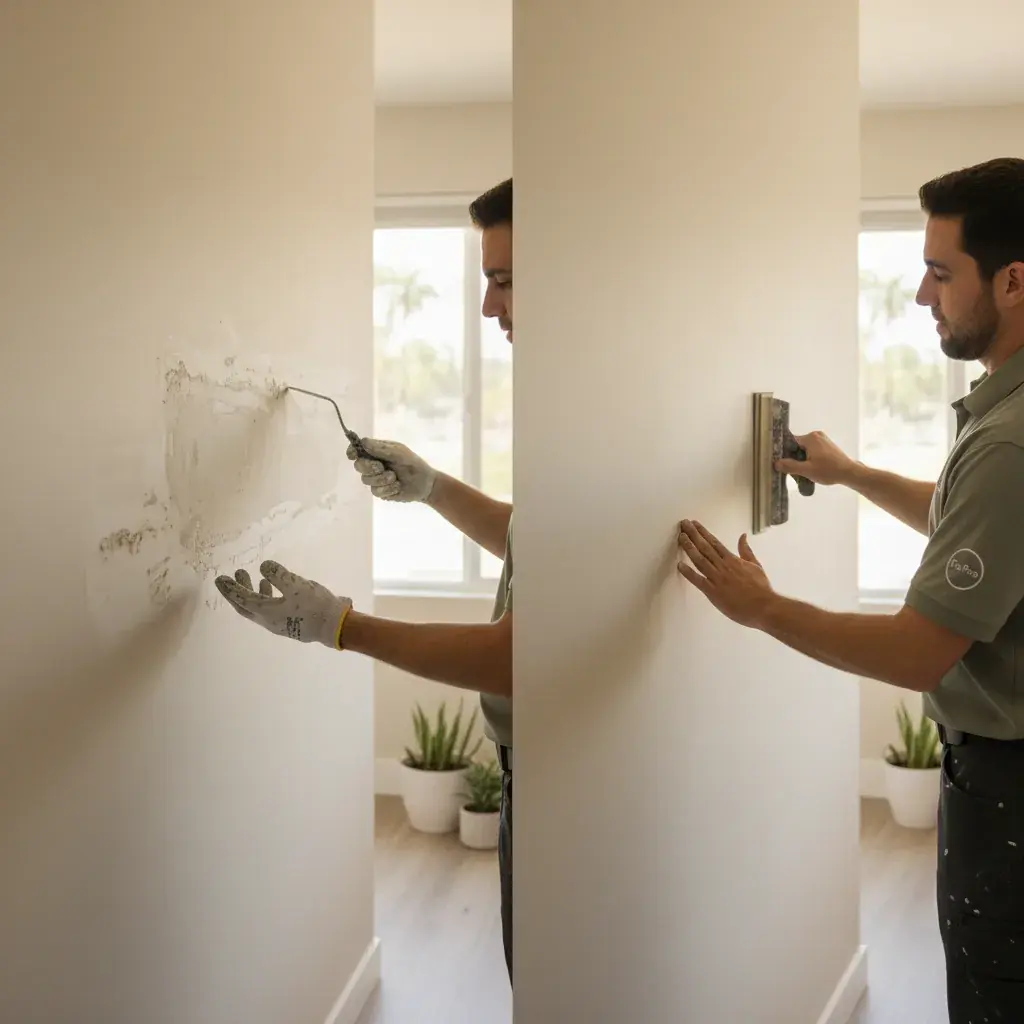
A small drywall hole is genuinely DIY-friendly. A drywall repair in a room with orange peel, knockdown, or skip trowel texture is a different job. Texture matching is where many DIY patches fail.
The reason isn’t the patching itself. It’s the texture application. Matching an existing texture requires the right compound consistency, the right spray pressure (for orange peel), and the right timing relative to drying, and it requires sampling on an inconspicuous area before touching the repair. Most DIY attempts skip the sample step and get the spray distance wrong. The result is a patch that looks fine in overhead lighting and stands out badly when sunlight hits the wall at an angle.
For San Diego homes specifically, the wide range of original textures, from smooth to heavy knockdown to California plaster, makes texture matching harder than in markets where one or two textures dominate.
Tile installation and repair
Tile is one of the most-botched DIY categories among common home repairs. The failure modes are predictable: insufficient thinset coverage (tile sounds hollow, then cracks), wrong grout type for the application (sanded grout used at the tub-to-tile junction, where it cracks within a year), or failure to account for substrate movement (tile installed directly over uncoupled substrate that shifts and cracks).
San Diego adds a specific complication: older homes in North Park, Normal Heights, and Kensington often have original Saltillo, clay, or handmade tile that can’t be matched with anything available at a home center. A DIY repair in these homes frequently uses visibly mismatched tile that reduces the home’s market appeal. Professional repair either sources a close match or, when no match exists, proposes a clean alternative treatment, an inset accent tile or a design change that makes the repair intentional rather than visible.
Door and window adjustment
Door sticking is a common homeowner complaint in San Diego County, and it is also a DIY repair that often goes wrong. The reason is misdiagnosis. Most homeowners plane the sticking edge when the real cause is a hinge that needs adjustment, a strike plate that needs moving, or seasonal wood movement that only requires awareness, not material removal.
Removing material from the wrong edge is irreversible. It also usually doesn’t fix the actual problem. Doors planed on the wrong edge still stick, just on a different edge.
The cost math when DIY goes wrong
Correcting a failed DIY repair almost always costs more than the job would have cost done right the first time, because a pro has to undo the failure before fixing the original problem. How much more depends on the job type. A failed paint job in a bedroom adds the cost of scraping, re-priming, and repainting. A failed tile installation in a shower that led to water damage behind the wall can multiply the cost several times over once demolition and substrate repair are factored in.
For San Diego, three cost categories are worth understanding:
Water-related failures compound fast. A shower re-caulk done incorrectly, caulk over existing caulk, wrong product type, or applied over a dirty joint, often fails in months rather than years. By the time the homeowner notices, water may have been migrating into the wall cavity. The repair at that point can include substrate work and tile, not just a new bead. Ask the quoting professional to separate a correct re-caulk from any moisture correction found on site. Fix Pro San Diego does not publish those dollar bands.
Texture and finish failures affect home value. Visible DIY repairs, mismatched textures, uneven caulk lines, and off-angle TV mounts reduce buyer confidence and often result in inspection-related price negotiations. Buyers read amateur repair work as a sign of deferred maintenance elsewhere, and that perception shows up in the offer.
California permit requirements homeowners frequently miss
Permit rules depend on the address and the proposed work. Confirm current requirements with City of San Diego Development Services or the authority serving another jurisdiction. A deck repair that involves joists or the ledger attachment is not automatically a cosmetic fix. Ask the quoting professional whether a permit applies before work starts.
Where DIY makes clear sense
Simple, single-step repairs with forgiving failure modes are reasonable DIY candidates:
- Painting a single room in a solid color (no trim, no texture matching)
- Replacing a cabinet hinge or drawer slide
- Basic caulking on a windowsill where the material choice is forgiving
- Furniture assembly from flat-pack kits
- Installing a ceiling fan on an existing fan-rated box with existing wiring
These jobs have lower stakes when they go wrong, do not require matching an existing finish, and do not involve water exposure or structural loading.
The actual decision framework
The most useful question isn’t “can I do this?”, it’s “what happens if I get it wrong?”
If the failure mode is visible but contained (a paint line that is not straight), DIY is reasonable. If the failure mode involves water intrusion, structural load, or surface matching that you cannot undo, hiring out is often the cheaper path even before you count your time.
For San Diego homeowners specifically: the marine layer, stucco walls, and coastal hardware exposure make moisture-related failures more likely here than in drier climates. The failure window is shorter. That shifts the calculation toward professional work in any repair category where water is involved.
Fix Pro San Diego matches homeowners with independent local professionals for the jobs where a failed DIY attempt is expensive to unwind: drywall repair and texture matching, tile and grout repair, caulking and sealing, door and window adjustment, and deck repair. The professional quotes the job before any work starts. Call (858) 400-4611.
Frequently asked questions
Which DIY home repairs fail most often? Complex multi-step jobs that involve surface matching, water exposure, or load-bearing installation fail more often than simple single-step jobs. Tile, texture-matched drywall, and door adjustment are common redo requests. The type of job matters more than a homeowner’s confidence.
Is it cheaper to DIY or hire a handyman in San Diego? For simple repairs, DIY is usually cheaper. For complex repairs, especially those involving texture matching, tile, moisture exposure, or load-bearing installation, DIY typically costs more once you account for the chance of a redo. The bigger the project, the more the stakes of a failed DIY attempt compound.
Would you rather hand this one to a pro than do it yourself? Call (858) 400-4611.
Request a quote