A vaulted great room in Lakeside, or a hanging light over an open stair, turns a fixture swap into an access plan first. The new glass and the old canopy matter. Reaching the box without scraping tile, a banister, or a sofa is what changes the visit.
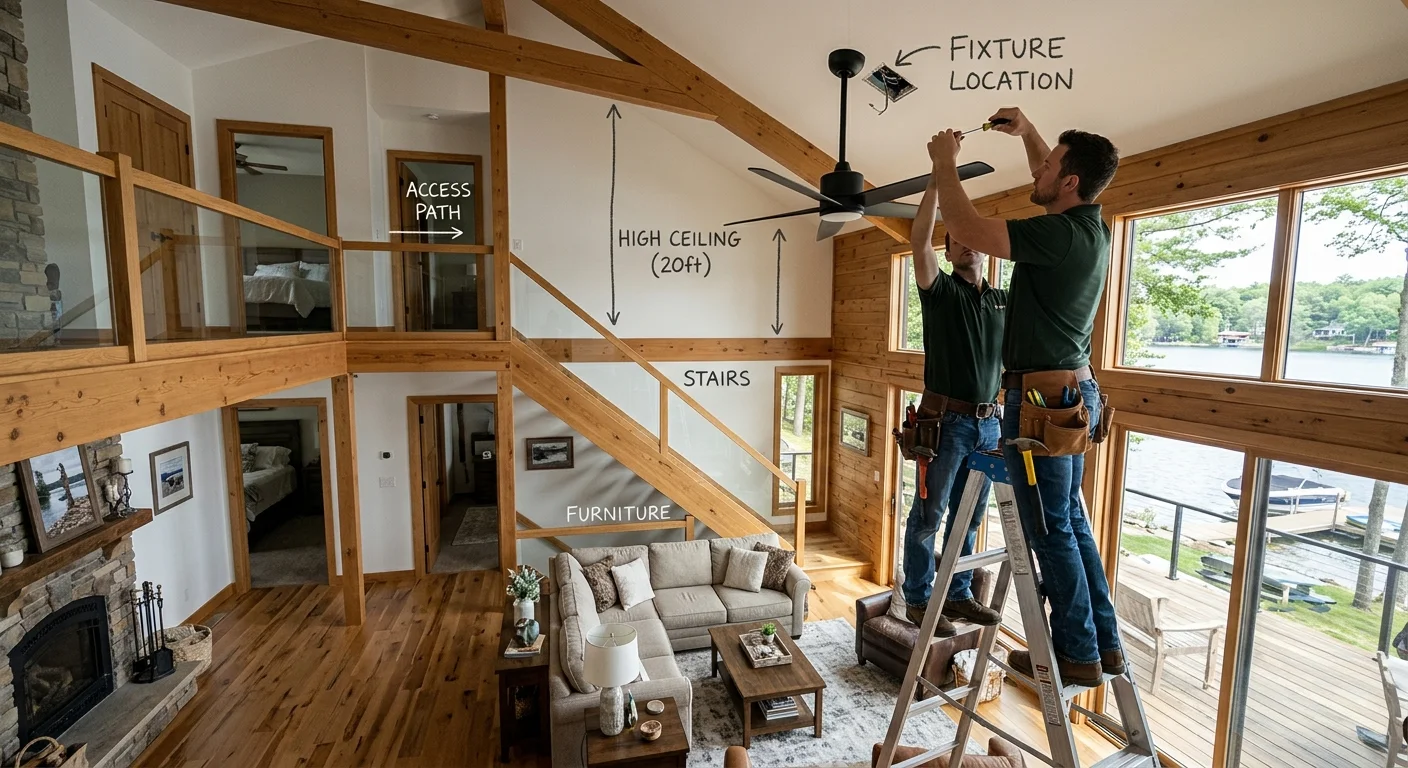
That is the real job behind light fixture installation in Lakeside. East County houses mix ranch rooms, split levels, and two-story volumes on hillside lots. A flush mount in a hallway is one request. A chandelier over a void is another. Write the height and the path before you talk product. People hunting affordable fixture installation San Diego County still need that same map. A low price search does not flatten a 16-foot well.
Record the fixture location and ceiling height
Name the room in plain words. Living room over the garage. Stairwell at the front door. Loft that looks down on the great room. Then say where the box sits in that room: center, over the table, over the landing, tight to a beam. A Lakeside pro who has never walked your house cannot guess which of those you mean.
Measure from a finished floor to the ceiling if you can do it from a stable spot. A tape on the wall, or a mark you already know from a prior paint job, is enough to start. If you cannot reach the ceiling safely, do not climb furniture. Write what you can see from the floor and label any number as an estimate. An honest “about 14 feet, not measured” is more useful than a confident guess.
Note the void under the fixture. Many Lakeside homes put a hanging light over stairs, a foyer, or a two-story living room. The floor under the box may be a landing, not a wide room. That changes how a person stands, where a helper can hold a fixture, and whether furniture even belongs in the picture. Write “over stairs” or “over open living room” in the same note as the height.
Describe the existing fixture in product language, not wiring language. Flush. Semi-flush. Pendant. Multi-arm chandelier. Glass bowl. Heavy metal frame. If the canopy is wider than a dinner plate, say so. If chains drop three feet, say so. You are recording what has to come down and what has to go up, not diagnosing the circuit.
Add one local cue that only your house has. A beam that splits the ceiling. A ceiling fan nearby that you are not touching. A skylight that cuts the walkable roof line. Winter Gardens ranch rooms and newer two-story houses off the SR-67 corridor fail in different ways. The first is often a long, low room with one high peak. The second is often a stair well with a fixture you cannot reach from the living-room floor. Put that distinction in the note so the request stays a Lakeside house, not a generic ceiling.
Map the approach path through the room
Start at the door the pro will actually use. Front door, garage, or slider. Then walk the route a person would take with a boxed fixture in their hands. Write every pinch: a half-wall, a tight turn at the stairs, a sofa that eats the center of the room, a dining table under the box. The path is the job as much as the ceiling.
Hillside lots above State Route 67 change this walk before anyone enters the house. The driveway may sit below the living level. Exterior steps, a long slope, or a narrow side yard can be the first squeeze. If the new fixture ships in a tall carton, say whether that carton can come through the door you named. A box that fits a two-car garage still may not turn the interior stair.
Homes off Lake Jennings Park Road can add a different first problem: a long carry from where a vehicle actually parks to the room with the high ceiling. If street parking is the only realistic stop, write that. If the garage is full and the only indoor route is through a kitchen, write that. Access planning is the walk, not the city name on the mailbox.
Inside the room, mark a clear footprint under the box. A rectangle on the floor is enough. Note what currently lives in that rectangle: table, rug, piano, sectional. Say what can move and what cannot. A built-in hutch stays. A coffee table can shift. If the only standing room is a stair tread, say “work from stairs” in one line. That single phrase tells a pro the visit is not a living-room ladder story.
Keep the map honest about finishes underfoot. Saltillo, tile, or a wood landing at the stair nose will change how people set their feet. You do not need a product name. You need “slick tile at the bottom of the stair” or “thick rug under the table.” Those notes stop a rushed setup from chewing a nosing or dragging a carton across a floor you care about.
If you are comparing this house with a flatter Poway layout, stop treating the quotes as twins. Affordable fixture installation Poway searches often turn on product and switch location. A Lakeside high-ceiling visit turns on whether a person can stand under the box at all. Use this path map here. Use a different planning page when the house is a one-story grid with a standard eight-foot lid.
Confirm replacement fixture and product details
Have the new fixture on site, or have the order sheet with the model, finish, and listed size. A photo of a showroom sample is a wish. A boxed product with a part number is a request. If the fixture is still in a cart, say so. The pro you are matched with cannot hang a light that is still at a warehouse.
Write the diameter, the drop, and the listed weight if the carton or the maker’s sheet prints them. Copy the numbers. Do not estimate weight by lifting the box and guessing. If the sheet is missing, photograph every side of the carton and the canopy. That is the whole of the product brief. No extra claims about what a ceiling box “should” hold. That call belongs to the person standing under your ceiling with the product in hand.
Say whether this is a same-spot swap or a different shape. A small flush mount coming off and a wide chandelier going on is not the same canopy conversation. If the new fixture needs a longer drop to clear a table, write the table height. If it is a tight semi-flush in a room with a ceiling fan on a nearby box, say you want the fan left alone. Keep this page on the light. Fan work is a different article and a different visit.
Match the request to what a replacement scope actually includes. A take-down, a hang, and a test at the same box is one shape. A new location, a new switch, or a fixture where there is only a blank ceiling is another. Put the product in the first shape unless you truly want the second. Mixing them in one sentence is how a Lakeside visit gets quoted as the wrong job.
Keep parts together. Mounting hardware, glass, bulbs if they came in the kit, and the instruction sheet should stay in the carton until the pro arrives. If a glass shade is already out of the box, photograph it in place on a table so chips are visible before anyone climbs. Product condition is part of access planning. A cracked shade discovered at the top of a stair well is a wasted trip.
Separate fixture work from new wiring requests
Say out loud whether you want the new light on the existing box, with the existing switch. That is fixture work. Wanting a light in a blank ceiling, a box moved off-center, a dimmer that is not there, or a second switch at the top of the stairs is a different request. Put those extras on their own line. Do not bury them inside “just swap the light.”
A high ceiling makes that split more important, not less. Reaching a live box over a Lakeside stair already fills a visit. Adding “while you are up there, run it to the loft” is a new plan. The matched local pro needs to know that before anyone sets a foot on the first tread. You are not asking for a legal ruling. You are keeping the work list from growing in the air.
This page does not confirm a County of San Diego permit line for a like-for-like swap in unincorporated Lakeside. Lakeside is not the City of San Diego, so city bulletin language does not apply here. If your request leaves the existing box, or you are not sure, ask the County of San Diego and the pro who will stand in the room. A blank from research is the honest answer. Filling that blank with a guessed rule is not.
Cost is a separate conversation from this access plan. If you want a county-wide read on how fixture visits get priced in general, use the San Diego light fixture installation cost guide. Do not paste those figures onto a two-story well off Lake Jennings Park Road and call it a bid. Height, stairs, and a boxed chandelier change the visit even when the fixture itself looks simple.
Write the electrical wish list in homeowner words. “Same switch, same box, new glass.” “Move the light over the table.” “Add a light on the blank ceiling at the landing.” Stop there. No circuit stories, no panel stories, no promises about what is “just a wire.” The person who sees the box decides what the box can take. Your job is to keep fixture hanging and new wiring from collapsing into one muddy ask.
Photograph stairs, furniture, and nearby finishes
Take photos standing where the work will happen, then take the same views from the door. One set from the floor looking up at the fixture. One set looking at the stair or the furniture that blocks the center. One set of the landing or tabletop where glass might rest. Daylight helps. A dark evening phone photo of a white ceiling tells almost nothing.
Shoot the stairs as a path, not as architecture. Include the handrail, the width of the treads, and the nose of each turn. If a fixture has to come down the stair, the carton has to make those turns. A photo of the whole staircase from the bottom is the single most useful Lakeside image you can send for a high-ceiling light. A close crop of the canopy with no stair in the frame is the least useful.
Photograph furniture you would have to move. Sofas, a dining table, a piano, a tall bookcase. If a TV or a top-heavy dresser sits in the only clear path, plan around it. The U.S. Consumer Product Safety Commission tells households to secure TVs and furniture per the maker’s instructions, including anchoring sets that are not wall-mounted and top-heavy pieces. Sliding a dresser “just for the afternoon” and leaving it unsecured is a separate problem. Move it, or leave it, and say which in the note.
Get the nearby finishes in the frame. Crown, a cracked drywall joint, popcorn, a beam, a paint line that already does not match. High work throws dust and the occasional scuff onto whatever sits under the box. A photo of the ceiling texture and the wall at the stair helps the pro talk about protection, not about a surprise patch later. If a rug is staying, photograph the rug. If the table is staying, photograph the tabletop.
Name the files before you send them. “Stair from foyer.” “Ceiling from landing.” “Table under fixture.” “Driveway steps from garage.” A folder of IMG_4581.jpg does not travel well. The same discipline you would use for any repair photo set applies here: the picture should answer a question the visit will hit in the first two minutes. Height, path, product, extras, and the floor under the work. That is the whole brief.
When to call us
Call when the fixture sits over a stair, a two-story room, or a path you cannot clear on your own, and you want a matched local pro to quote the hang before anyone starts. Fix Pro San Diego connects you with independent Lakeside-area handyman pros. It does not climb the well or own the tools. Call us at (858) 400-4611 and we’ll match you with a local pro who quotes the job before starting.
Would you rather hand this one to a pro than do it yourself? Call (858) 400-4611.
Request a quote