A stain under a North Park balcony or a wobbly rail in La Mesa is the part you notice first. The floor, the posts, and the line where the balcony meets the house all belong in the same notes. Walk that path before you request balcony repair in San Diego, so the independent pro you talk to is looking at the same assembly you live with.
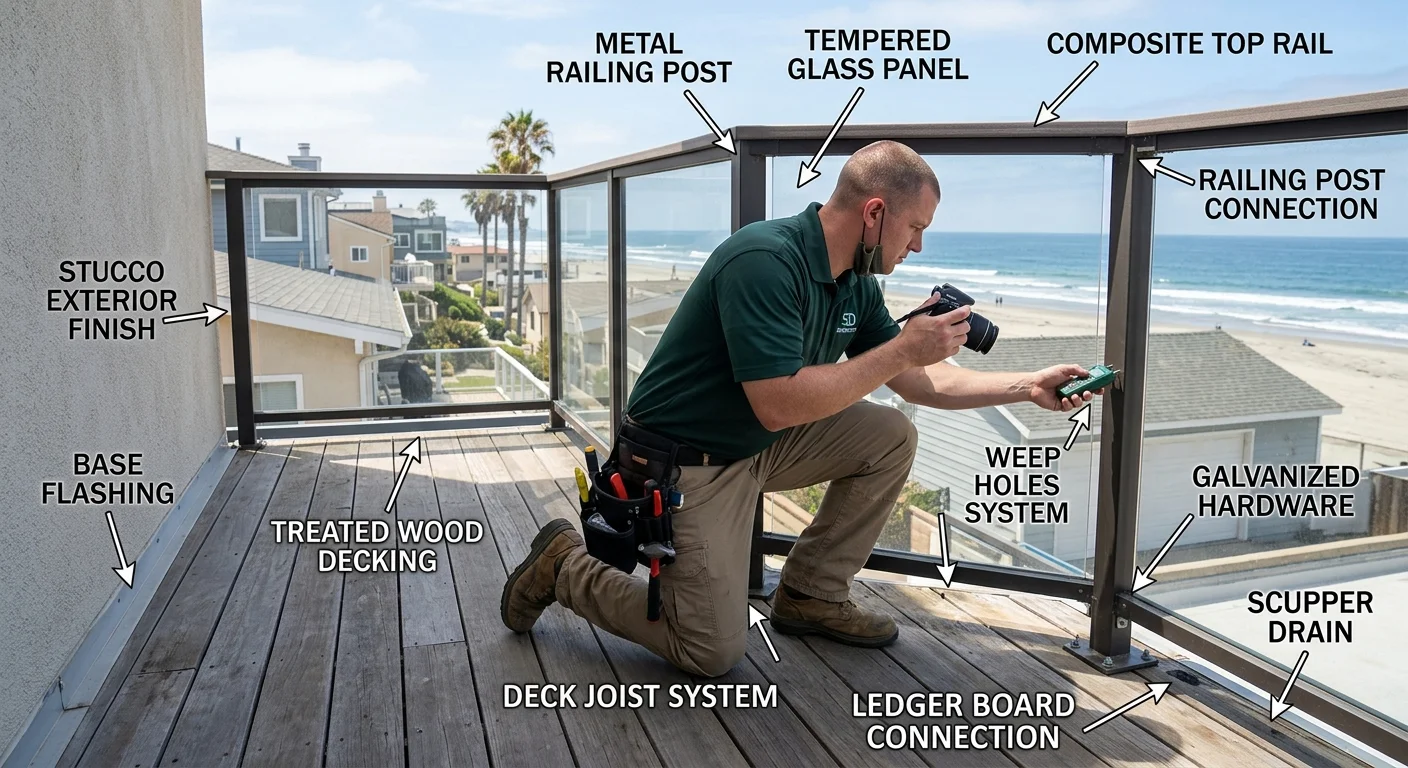
Map the balcony floor, railing, and connections
Start at the door that opens onto the balcony and write which room it serves. A Mission Beach condo, a Hillcrest flat, and a Chula Vista townhome put that door in different places, and that changes later access.
Walk the floor in a simple grid. Stand at each corner, then in the middle. Write what your feet feel: firm, springy, or uneven. Do not jump. Do not stack people or extra furniture to test the span. You are mapping what you notice, not proving a rating.
Look at the walking surface as a plan, not a single board. Count boards or panels out from the house wall. Mark any low corner where rinse water or rain sits. Mark any drain, scupper, or open joint at the threshold. If the balcony sits over a bedroom, a kitchen, or a garage, write that room on the same page. A balcony is not a yard deck. It usually ties into an upper wall and often sits over finished space.
Move to the railing. Start at the opening and run a hand along the top rail. Stop at each post. Note whether the post sits on the floor, passes through the floor, or ties into the wall. If a post shifts when you rest a hand on it, number the post and write the direction it moved. Keep this pass on this balcony. A longer walkthrough of rail hardware lives in our deck railing inspection notes before quotes.
Finish with the connections. That is the joint at the house wall, plus any visible bracket, ledger board, or flashing lip. Many San Diego walls here are stucco. Look at the stucco return, the paint line, and any gap or stain at that joint. If you can see the underside from the yard, the alley, or a lower patio, note stains, peeling coating, or open gaps. You are not naming a cause. You are pointing a later reviewer to a spot.
Sketch a plan in the notebook. Label the house wall and the door. Number the posts. A balcony in Pacific Beach or Imperial Beach sits closer to the ocean than one in El Cajon or Escondido. Write the neighborhood on the sketch so the notes stay tied to that place.
Separate surface damage from framing concerns
Keep two lists. Surface wear is what you see without opening anything: peeling coating, faded or split boards, rust bloom on fastener heads, cracked tile, open caulk, dirt in a low corner. Framing concerns are what you cannot confirm from the walking surface: joists, ledgers, hangers, and the inside of a post base. Mixing the lists makes a later quote request muddy.
If a board is cupped, split, or missing a fastener, put it on the surface list and count boards out from the house wall. Repair or replace damaged deck boards covers that choice for walking surfaces. A balcony board can look similar and still sit over a bedroom or a garage, so keep a line on the page for the room below.
Soft spots, bubbling paint near a post, or a crumbly edge go on a second list labeled “needs a closer look.” Do not call that list structural. A shoe and a phone camera do not prove framing condition. If the wood looks punky or the coating lifts in a line, note that dry rot repair in San Diego may come up in the later review. Let the pro name what it is.
Stains on the ceiling of the room below, or on a garage under a rear balcony in Clairemont or Linda Vista, go on that second list. Write the room, a rough size, and whether the mark looked darker after rain. Do not draw a water path from the balcony into the house on your own.
Scope, not your photo set, drives licensing. California’s current minor-work exemption under Business and Professions Code section 7048 applies to casual, minor, or inconsequential work below $1,000 including labor, materials, and all other items, and only when the work does not need a permit and is not part of a larger job. Dividing a job to stay under that figure does not create the exemption. Neither does advertising as a contractor. The Contractors State License Board tells consumers that a license is required for projects that need a permit, use employee labor, or cost $1,000 or more. A single-trade project can require a specialty contractor rather than a general contractor. If the later review points to framing, flashing, or anything that needs a building permit, plan on a licensed contractor.
In the City of San Diego, Information Bulletin 203 lists some minor in-kind maintenance under $1,000 that does not need a building permit, except on designated historical resources or in historic districts. That bulletin is city-specific. It does not speak for Oceanside, El Cajon, or unincorporated county pockets. Confirm with the city that issued your last permit before you treat a coating touch-up as maintenance.
Record materials, fasteners, and access
Name the walking surface in plain words: wood boards, composite, a coated sheet, tile, concrete, or metal. If you do not know the product, describe color, width, and whether the edge is square or bullnose. A guessed brand does not help.
Then fasteners. Note screw heads, nails, lags, or hidden clips. Note rust, missing heads, or heads pulled into the board. Leave them in place. Do not probe a post base with a screwdriver. Photograph a rust cluster and count the heads.
Write the wall finish at the door and along the ledger line: stucco, siding, or trim. Note cracked stucco, open caulk, or a metal flashing lip if you can see one. Failed caulk is a location marker.
Access is the note balcony repair contractors in San Diego often have to reconstruct later. Measure the door. Note a tight hall, a bedroom-only path, or a third-floor unit with no exterior stair. Downtown and Golden Hill rear balconies often open only from a bedroom. Encinitas and Carlsbad hillside units may offer no safe view of the soffit from the yard. Write how you saw the underside, or that you could not.
If an HOA or a landlord controls the exterior, copy the association name as it appears on your papers. Do not interpret the CC&Rs. Attach the page that mentions exterior elements.
If the house was built before 1978 and paint may be disturbed, the EPA Lead Renovation, Repair and Painting program is the federal rule a later crew follows. Note the year built if you have it from a disclosure or county record.
Those material and access lines also keep a later deck and fence repair scope from mixing a small surface fix with a larger licensed job.
Compare one area with the full balcony
One bad board is not the balcony. After the close notes, compare every bay.
If one corner holds water and the far corner is dry, write both. If post 2 moves and post 5 does not, write both. Independent pros price from the whole assembly. A request built on the worst photo can miss a repeating pattern.
On a long balcony, number the bays from the door. South Bay and Pacific Beach multifamily buildings often share a walk. Keep unit numbers in the file if you have them. You are documenting your unit and what you can see, not inspecting the whole building.
Compare this balcony with any other elevated piece on the same wall: a landing, a small deck, a stair. If the stair is damaged, give it its own list. That is a different assembly.
Sun and shade split this county. A west-facing balcony in Point Loma takes afternoon sun. An east-facing balcony in La Mesa sits in a different light. A unit in Alpine or Ramona sits farther inland than one in Ocean Beach. Note the facing direction if you know it. Note trees that drip on the rail. Note a roof downspout that dumps into a corner. These are observations about this property, not a county-wide wear ranking.
If two areas match, say they match. Isolated wear at one post is just as useful. The goal is to stop a later visit from treating one close-up as the whole floor.
Photograph the balcony before requesting inspection
Shoot in daylight. Thin cloud is better than hard noon glare on a Mission Beach coating.
Wide shots first. One from the doorway looking out. One from each end. One from the yard or alley looking up, only if you can stand there without climbing. Then close shots: each post base, the house-wall joint, stains, cracked coating, rusted fastener groups, and the drain if there is one.
Set a tape measure or a notebook in one close shot for scale. Stay off the rail. Do not lean out for a soffit picture. If you cannot see the underside, write that.
Name files by spot: post-3-base, ledger-stucco, room-below-stain. Date them.
Send the sketch, the two lists, the access notes, and the photos together. Ask the pro to walk the same map. Check the license on CSLB’s site before you hire. CSLB tells consumers to get at least three written bids, to watch bids that sit far below the others, and to confirm identity. For licensed home improvement work, a down payment cannot exceed 10% of the contract price or $1,000, whichever is less. The written contract should describe the work, materials, and timeline. Change orders need both signatures. Workers’ compensation is required for contractors with employees. If a worker is injured on your property and the contractor lacks that insurance, you may be financially liable.
Do not ask anyone to price hidden framing from photos alone. Photos show what is visible. Openings, readings, and permit questions happen on site. In the City of San Diego, permit questions go through Development Services. Other cities in the county run their own counters.
When to call us
When the notes go past a scuff or a single loose board, hand the balcony to a licensed local pro instead of guessing from photos. Fix Pro San Diego matches you with independent pros and does not repair balconies itself. Call us at (858) 400-4611 and we’ll match you with a local pro who quotes the job before starting.
Would you rather hand this one to a pro than do it yourself? Call (858) 400-4611.
Request a quote