New flooring frames every mark at the wall. Home repairs in San Diego that sit on doors, baseboards, cabinets, and drywall should be listed and finished while the old floor is still the work surface. A North Park plaster chip, a Chula Vista tile kick, and a Mira Mesa door that already scrapes all read as a picture frame once the plank goes down.
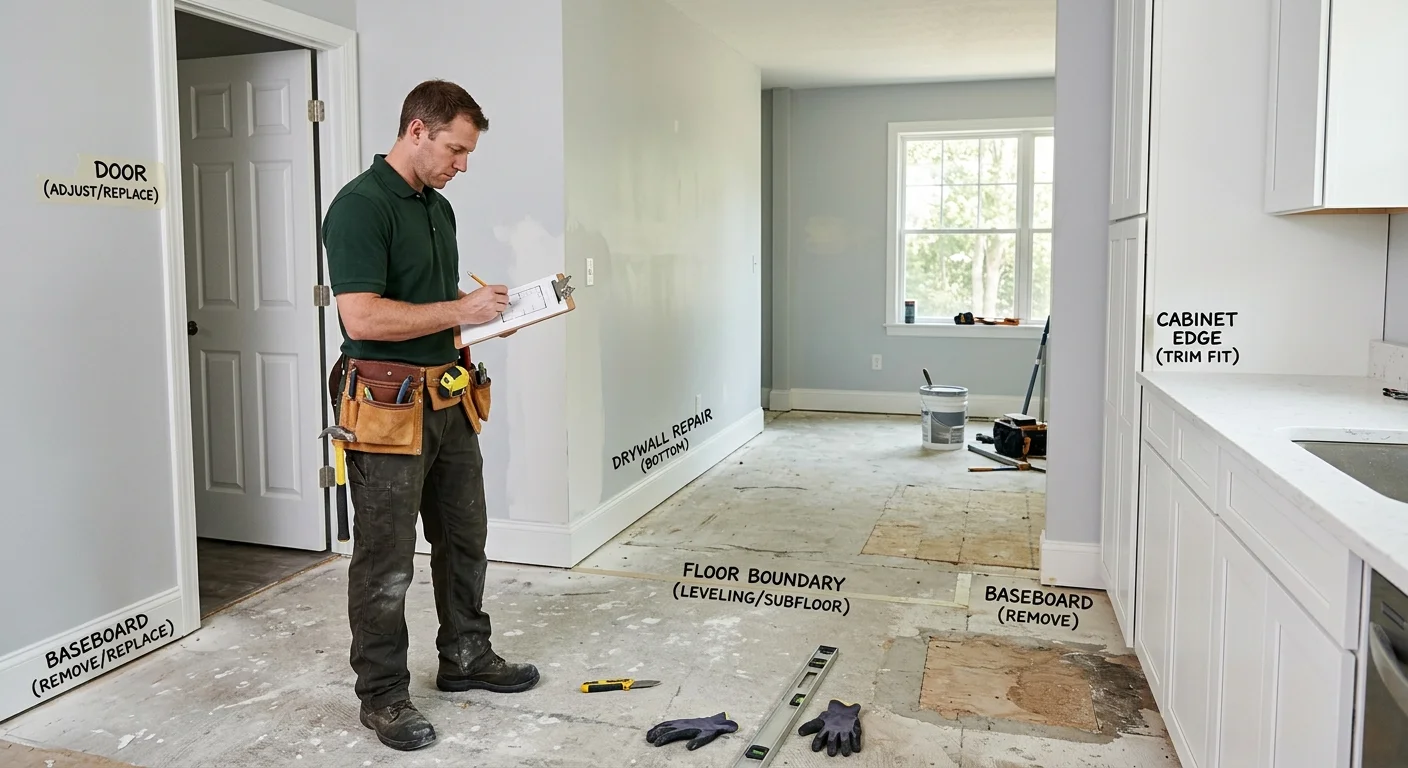
List repairs touching walls and floor edges
Walk each room that will get new flooring with the old floor still down. Write every mark that touches the joint where wall meets floor. That list is the real home repair San Diego homeowners need before a flooring bid, not a whole-house remodel. Flooring will not hide a kicked corner, a missing shoe mold, or a cabinet that hangs past the slab.
Start at the baseboards. Note splits, paint ridges, loose sections, and pieces already pried off. Coastal Encinitas, La Jolla, and Ocean Beach beat up lower trim with salt air and sandy feet. Inland Escondido, El Cajon, and Santee see more shrinkage and open miter joints from heat. Write the room and the wall, not a vague “trim.”
Move to the drywall or plaster. Look for vacuum dings, pet damage, and the gray paper edge that shows when old carpet tack strip sat proud of the wall. Central neighborhoods such as North Park, University Heights, South Park, and Mission Hills often have plaster. A plaster chip at the floor is a different repair than a gypsum patch in a 1980s Scripps Ranch or Rancho Peñasquitos tract. Put the wall type on the list.
Check cabinet boxes in kitchens and baths. Toe kicks that rest on the finished floor will fight a thicker plank or a different tile height. Vanities in Chula Vista, National City, and San Ysidro often sit on old tile. If that tile is leaving, the vanity edge is a repair, not a flooring detail. End panels that face a living room in Allied Gardens or Clairemont ranch houses belong on the same list.
Add door casings that die into the floor, closet tracks, floor registers, and the last stair nosing if a hallway floor changes. Home repair, in this moment, means restoring those existing parts so the flooring crew has a clean stop. If a nick sits higher than a baseboard but the crew will work against that wall, write it anyway. Pros bump corners. You want that corner planned, not found mid-install.
Separate flooring work from other requests
Keep two lists. One is the floor: tear-out, underlayment, new material, transitions. The other is everything that is not the floor: doors, drywall, cabinets, trim, paint. Mixing them in one request makes quotes impossible to compare. One pro prices planks. Another prices carpentry and trim work. A third prices general home repairs. You cannot rank those bids against each other.
California licensing follows the job, not the nickname on the invoice. The Contractors State License Board tells consumers a license is required for work that needs a permit, uses employee labor, or costs $1,000 or more, counting labor, materials, and every other item. Check the license before you sign. The right classification depends on scope. A single-trade job can need a specialty contractor rather than a general contractor.
Business and Professions Code section 7048 covers casual, minor, or inconsequential work below $1,000, including labor, materials, and other items, and only when no permit is required. It does not apply when the work is part of a larger operation, when jobs are split to stay under that number, when someone advertises as a contractor, or when they employ others to do the work. Price alone is not permission. Wall patches bundled with a whole-house floor can read as one larger project. Ask each pro which list they are bidding, and keep flooring and repairs on separate written scopes.
Confirm permit questions with City of San Diego Development Services if the house sits inside city limits. Other cities and the county run their own counters. The city publishes work that does not need a building permit, including some minor repairs under $1,000 that replace components with similar materials and do not touch electrical, plumbing, or mechanical systems. Door and window replacement in a single-family, duplex, or townhouse can sit in that group when openings stay the same and no fire-resistive upgrade is required. Drywall patches up to 100 square feet tied to electrical, mechanical, or plumbing repairs are listed too. Designated historic resources and historic districts are carved out. If you live in Golden Hill, Sherman Heights, or Mission Hills, check that first.
Record doors, trim, cabinets, and drywall
Stand in each doorway and close every door that will swing over the new floor. Mark hinge side, swing, and whether the bottom already scrapes. Coastal humidity in Point Loma and Imperial Beach swells wood. Inland dryness in Poway, Ramona, and Lakeside shrinks it. The same slab door behaves differently ten miles inland.
Note bifolds and sliders. Closet sliders in Clairemont and Mira Mesa tract homes often sit in a floor track the new material will bury or raise. That is a door job, recorded now, not a surprise after the vinyl is down. Photograph each casing where it hits the floor. Split jambs, chewed pet corners, and thick paint ridges all change how a carpenter cuts once floor height changes. Catch that work while the old floor is still the platform. You will still face baseboard gaps after flooring if you skip the line at the wall.
Open every base cabinet. Shoot the toe kick, the end panel that faces a room, and any filler strip. In South Bay kitchens, tile often runs under the kick. In Rancho Bernardo and Carmel Mountain condos, laminate may already sit flush. Write what the cabinet sits on. If a dishwasher panel or fridge return is in the path, add it.
On walls, record holes, texture, and whether you have orange peel, knockdown, or plaster. A quarter-sized hole at the baseboard is one patch. A long furniture gouge is another. Water stains at a patio slider in La Mesa or El Cajon need a note even if the leak looks old. Do not guess at structure. Write what you see and leave the call to the pro. Keep names tight: “hall bath door, hinge side, scrapes at latch,” not “doors.” San Diego home repairs quote cleanly from that sentence.
Plan removal and installation boundaries
Sketch each room. Mark where flooring starts and stops. Hall to bath, kitchen to living, and bedroom to closet are the usual fights. Write who owns each edge so two trades do not both skip it.
Decide who pulls the old baseboards. If a flooring crew pulls them, they own the leftover pieces. If a carpenter pulls them as a repair, that belongs on the handyman list. Do not let both assume the other will bag the trim. Decide who undercuts door casings. Undercutting is a flooring move. Repairing a cracked jamb after the saw is carpentry. Put the repair on your list before the saw comes out.
Cabinets: flooring usually dies at the toe kick. If you want the floor under a vanity, that vanity has to come out first. That removal is a repair and a reinstall, not a flooring line item. Same for a built-in bookcase in a 1950s Allied Gardens living room, or a wet bar in a Tierrasanta family room.
Stairs and level changes need a named stop. If only the upstairs hall in a split-level Santee or Spring Valley house is getting new material, the nosing at the top step is a boundary. If a Linda Vista living room meets a sunken den, that riser is a boundary. Note every floor register. Moving a register is often more than a patch. If you do not know, put it on the flooring question list, not the repair list.
A patched corner that will show after new plank or tile needs paint after the patch. Confirm the year on Encanto houses, older coastal stock, and mid-century inland tracts before anyone sands or scrapes paint. Do not sand a mystery coating.
Build one photo set before requesting proposals
One photo set beats five phone tours. Shoot the same rooms for every pro. Our guide to photograph home repairs before quotes covers angles. For flooring prep, add shots the general list does not stress.
Take a wide shot from the doorway that shows the whole floor field and every wall. Then a mid shot of each wall-floor joint. Then a close-up of each defect with a ruler, a coin, or a tape in the frame. Repeat for every door bottom, every cabinet kick, and every transition to a room keeping its old floor.
Use daylight. Turn on overheads in a windowless hall, common in older City Heights, Normal Heights, and Logan Heights floor plans. Do not mix flash and no-flash in the same set. Name files by room and defect: “master-west-baseboard-split.jpg.” Keep the written list in the same folder.
When you request proposals, send the folder and say whether the flooring material is chosen. If the mill thickness is known, write it. If it is not, say so. A door cut changes when the finished height changes. Do not empty the room unless the furniture is leaving. A king bed against the only damaged wall is part of the job. Send the same pack to the flooring company and to the repair pro. Ask each to mark which photos sit in their scope. The leftover photos are the next request, not a surprise on install day.
When to call us
If the list has more than a couple of door bottoms, wall patches, and cabinet edges, hand the repairs to a pro so they stay off the flooring contract. Fix Pro San Diego matches you with a licensed independent local pro. The pro quotes and does the work. Call us at (858) 400-4611 and we’ll match you with a local pro who quotes the job before starting.
Would you rather hand this one to a pro than do it yourself? Call (858) 400-4611.
Request a quote