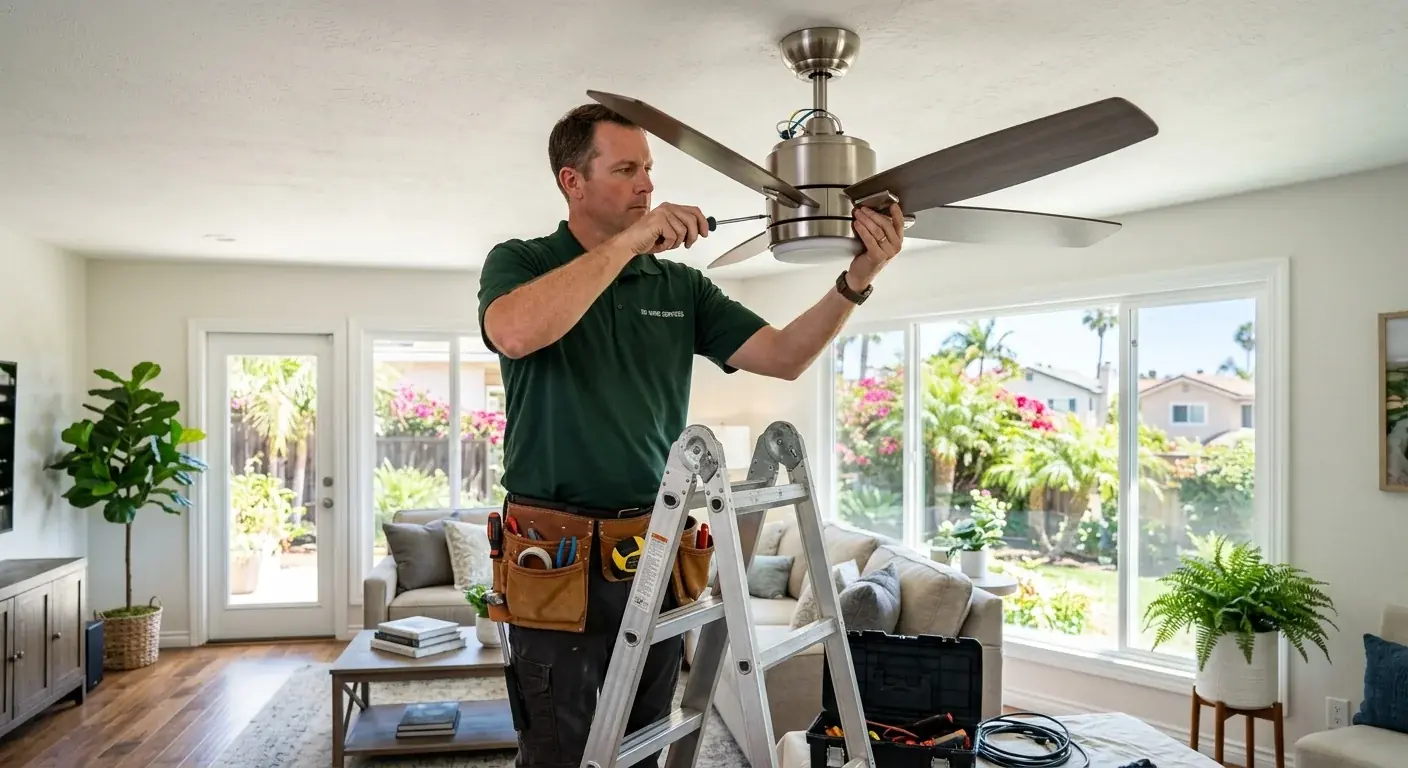
A handyman can install a ceiling fan in a San Diego home when there is already a fan-rated box, or a light fixture whose box can be swapped for one, and the wiring already reaches that spot. That is the job people mean by “handyman to install ceiling fan.” A new circuit pulled from the panel, a panel upgrade, or a dead circuit that needs diagnosis is electrician work, not a handyman swap.
The matched pro quotes the visit before opening the ceiling. You pay that independent pro directly. For the install itself, see ceiling fan installation in San Diego and the light fixture service.
What’s the average cost for a handyman to install a ceiling fan?
There is no verified single market average in the available evidence. As one local example, The Handyman San Diego’s pricing page, captured September 13, 2026, lists Ceiling Fan Installation - $200–$400. That page also states a $150 minimum service visit applied toward completed work, bills materials separately, and says the listed figures reflect labor only. Those are that provider’s advertised terms, not Fix Pro prices or San Diego averages.
A quote should state whether it covers fan assembly, removal of an existing fixture, mounting, disposal, testing, and any separate electrical work. The existing box must be confirmed as suitable for fan support, and a qualified, licensed electrician should assess wiring or box changes.
When you call Fix Pro San Diego, we’ll match you with a pro who provides a detailed quote for the job. Ceiling-fan work is a common light fixture request. Factors like the fan’s weight, the complexity of its assembly, and existing wiring can change the labor.
Pricing: new installation vs. replacing an old fan
The biggest factor influencing your ceiling fan installation cost is whether you’re performing a straight replacement or a completely new installation. These two scenarios have distinct requirements and, therefore, different price points.
Replacing an existing ceiling fan or light fixture
If you’re simply replacing an old, non-functional ceiling fan or swapping out an existing light fixture for a new fan, the job is generally straightforward. This is because the necessary wiring and a fan-rated electrical box are usually already in place. A handyman will typically:
- Safely disconnect and remove the old unit.
- Assemble the new fan (if not pre-assembled).
- Wire and mount the new fan to the existing electrical box.
- Test the fan for proper operation and balance.
This is the most common and often the most budget-friendly scenario.
New ceiling fan installation where no fixture exists
Installing a ceiling fan in a location where there’s currently no light fixture, or only a standard light fixture box that isn’t fan-rated, is a more involved process. This “new installation” might require:
- Installing a new, fan-rated electrical box and mounting brace to support the fan’s weight and movement.
- Running new electrical wiring from an existing power source (like a nearby switch or outlet) to the ceiling location.
- Installing a new wall switch to control the fan and light (if applicable).
It’s important to differentiate this from needing a brand new circuit run from your electrical panel, which usually requires a licensed electrician like Bright Pro Electric. For a deeper dive into the installation process itself, you can read our guide on ceiling fan installation in San Diego.
Costs for high ceilings or complex wiring
Some ceiling fan installations come with unique challenges that add to the overall cost. These are important to consider when budgeting for your San Diego home project.
High ceilings
If your ceiling is particularly high, say over 9 feet, the installation becomes more complex and time-consuming. A handyman will need specialized tall ladders, scaffolding, or extended poles to safely reach the mounting point and properly install the fan blades. This extra equipment and the increased time and care required to work at height will typically add to the labor cost.
Complex wiring scenarios
Most modern ceiling fans come with both a light and a fan motor, often requiring two separate switches for independent control. If your existing wiring only has a single switch leg (common with older simple light fixtures), additional wiring work is necessary to add a second switch. This can involve fishing new wires through walls and ceilings, which significantly increases labor. Similarly, if the electrical box is improperly grounded, damaged, or not suitable for the fan’s weight, it’ll need replacement or reinforcement. These are situations where a qualified professional should confirm the box, wiring, and any license or permit requirement before work starts.
Do you need an electrician or can a handyman do it?
This is a critical distinction for any homeowner considering ceiling fan installation. Knowing when to call a handyman versus a licensed electrician can save you time and money, and it keeps the project on the right trade.
ESFI strongly recommends hiring a qualified, licensed electrician to perform any electrical work in your home. A quote should separate fan assembly and mounting from any electrical-box, wiring, switch, or circuit work, and identify who will perform each part:
- Replacing an existing ceiling fan: As long as the existing electrical box is fan-rated and the wiring is sound, a handyman can remove the old fan and install the new one.
- Replacing a light fixture with a ceiling fan: If a standard light fixture is currently in place, and the junction box can be adequately reinforced or replaced with a fan-rated box by extending existing wiring, a handyman can often manage the conversion.
- Simple new installations: If a power source is readily available nearby (e.g., from an existing switch or outlet) and no new circuits are required from the main electrical panel, a handyman can run new wiring to the ceiling location and install the fan and switch.
However, there are specific scenarios where you absolutely need a licensed electrician. You should call an electrician if your project involves:
- Installing a completely new circuit: This means running wires all the way from your home’s main electrical panel to the fan location.
- Upgrading your electrical panel: If your current panel can’t handle the additional load of a new fan or other appliances.
- Complex troubleshooting: If you have intermittent power issues, flickering lights, or other signs of underlying electrical problems.
- Changes to your home’s main electrical service.
Fix Pro San Diego is a referral service. The matched professional must define the scope, credentials, exclusions, and price in a written quote. You can verify a contractor through the CSLB license check.
How to get an accurate quote for your project
Getting a precise quote for your ceiling fan installation in San Diego is straightforward when you’re prepared. To help the independent pro provide the most accurate estimate, have some key information ready when you contact us.
Consider these details:
- What’s the current situation? Are you replacing an existing ceiling fan, swapping out a light fixture for a fan, or installing a fan in a spot with no current electrical fixture?
- Ceiling height: Measure the height of your ceiling at the installation point.
- Fan type: Note whether you already have the fan, plus its make, model, and whether it’s particularly heavy or complex to assemble.
- Desired control: Do you want a pull chain, a wall switch (single or dual for fan/light), or a remote control?
- Existing electrical issues: Note any known problems with the wiring in that area of your home.
Providing these details lets the pro understand the scope of work and potential complexities upfront. They can then walk you through the specific labor costs, any materials they’d supply (like a new fan-rated electrical box), and give you a clear estimate before work starts.
When to call
When you need a new ceiling fan installed or an old one replaced, and the project doesn’t require complex new circuit wiring, call Fix Pro San Diego. Call us at (858) 400-4611 and we’ll match you with a pro for a walkthrough and quote.
Would you rather hand this one to a pro than do it yourself? Call (858) 400-4611.
Request a quote