
A ceiling fan can move air on a warm Santa Ana day without running the AC. Before you buy, check the ceiling, the box, the listed product instructions, and the switch wiring. Those details prevent a return and keep the written quote honest.
Four checks before you buy
A fan is heavier than a typical light and it moves. Confirm these points against the fan manufacturer’s instructions and the box rating, not a generic chart.
-
Structural support. The fan needs backing that the manufacturer allows, usually a joist or a listed brace between joists. It should not hang from drywall or plaster alone. If you are replacing a light, a solid thud near the box can hint at framing; a hollow sound can mean the box is only in the finish. Confirm on site with the power off.
-
A fan-rated electrical box. The box must be listed for fan support. A standard light-fixture box is a different product. Look for the manufacturer’s fan-support marking after the circuit is off.
-
Ceiling height. Follow the fan’s listed blade-to-floor clearance. Hugger or flush-mount fans exist for shorter rooms. Taller rooms often use a downrod. Use the length the manufacturer lists for that ceiling height.
-
Blade clearance. Follow the listed clearance from walls and sloped ceilings. Measure the room before you pick a diameter.
Older San Diego boxes versus newer builds
The junction box is the usual surprise. Confirm listed fan weight against the listed box rating. Do not assume a number from appearance.
In older San Diego homes, such as Craftsman bungalows in North Park or 1950s ranch houses in Clairemont, existing ceiling boxes are often small metal pancake boxes meant for a light. Hanging a moving fan from an unrated box is a safety problem.
Newer homes in places like 4S Ranch or Otay Mesa are more likely to already have a fan-rated box, even when a light is there now. That is a pattern, not a guarantee for one address.
The safe check is to turn off the breaker, remove the existing fixture, and look for a stamp that the box is acceptable for fan support. If it is missing, the box needs a listed replacement that fastens to framing. For local permit questions, ask the authority serving the address. The City of San Diego Development Services site is a starting point for city addresses, not a substitute for that determination.
Sloped ceilings, vaulted rooms, and downrods
Vaulted and sloped ceilings are common here. A standard canopy on a pitch can leave the fan unlevel. Many brands sell a sloped-ceiling adapter. Use the slope limit listed for that hardware, not a guessed angle.
The downrod lowers the fan. Manufacturers publish length tables by ceiling height. Measure at the install point and buy the listed rod with the fan. A fan mounted too high moves less air where you sit. A fan mounted too low is a clearance problem.
Smart-fan wiring
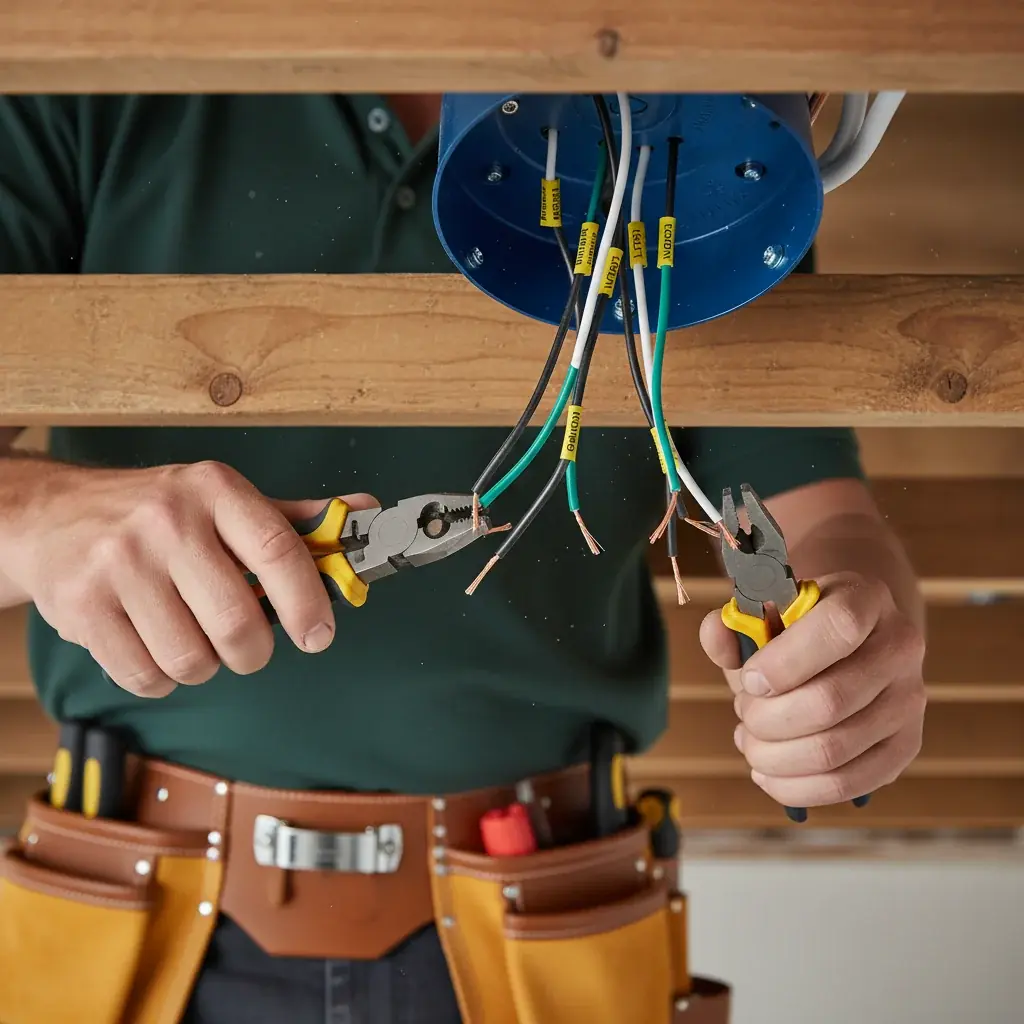
Many homes have a cable with one hot, one neutral, and a ground to the ceiling box. That setup can run a fan whose wall switch is only a master on/off, with speed and light on a pull chain or remote.
Separate wall controls for fan and light often need an extra switched conductor. If the fan’s listed control needs that conductor and the box does not have it, you can still install the fan and use the included remote, or you can get a separate electrical quote to run new cable. Cutting drywall to fish cable is not a fixture-swap scope.
Replacing a light versus adding a fan from scratch
The ceiling fan installation cost page covers quote questions. This page covers what changes the work.
Replacing an existing light or fan. Wiring may already be present. The work is then removal, confirming or replacing the box, assembling the new fan, and connecting to the existing conductors if they are suitable.
Adding a fan where none exists. That can include a new cable, a new fan-rated box and brace, a new switch, and finish repair. Ask a licensed electrician to quote new circuits and new locations. Confirm permits with the authority serving the property.
When the work belongs with an electrician
ESFI strongly recommends hiring a qualified, licensed electrician to perform any electrical work in your home. The professional should confirm the existing box, wiring, switch, circuit, and permit scope before opening the ceiling.
Call a licensed electrician when the work needs a new circuit from the panel, the wiring is damaged or unknown, or the project changes circuits in the home. A like-for-like fixture swap at an existing box is a smaller question. Describe the plan and we’ll match you with the right trade.
Already have a fan that wobbles, makes noise, or lost a pull chain? The ceiling fan repair guide covers those requests.
Ready for a quote
Record the ceiling height and send photos of the existing fixture plus the new fan model. A qualified professional should confirm the support, box, wiring, clearances, and product instructions, then quote the defined work.
Call (858) 400-4611 and we’ll match you with a local pro who quotes the job before starting.
Would you rather hand this one to a pro than do it yourself? Call (858) 400-4611.
Request a quote