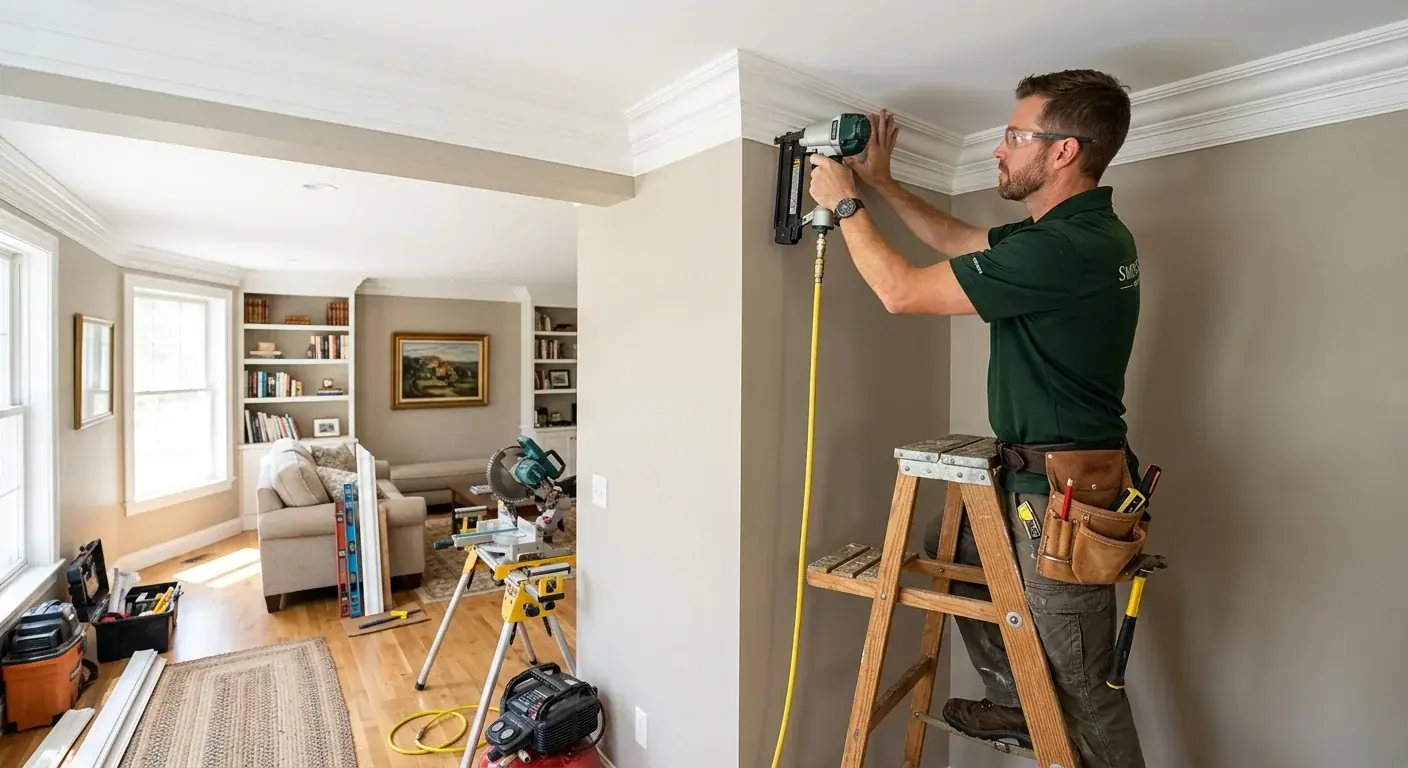
Crown molding installation quotes in San Diego depend on measured footage, profile, material, corners, ceiling height, prep, finish, and access. There’s no single per-foot rate that fits every room. Give each pro the same details, then compare the included cutting, coping, fastening, caulking, sanding, and finishing work. Fix Pro San Diego matches you with an independent local pro who quotes and contracts with you directly.
How to compare crown molding installation prices
No approved source supports a universal San Diego per-foot rate for this site. Start with measured footage and give every pro the same room plan, profile, material, finish, and access information.
Material choice can change both purchasing and finishing work. MDF offers a uniform paint-grade surface. Pine and poplar provide real-wood options that can be painted, while hardwoods may be selected for a visible grain and stained finish. Polyurethane products have their own installation and coating instructions. Confirm current material prices with the named supplier and ask the installer to identify the exact product in the quote.
The labor scope may cover layout, cutting, coping corners, fastening, caulking seams, filling nail holes, sanding, and finishing. Complex profiles, high ceilings, and rooms with many corners can add work. Require each quote to state which of those steps it includes. Fix Pro San Diego makes the referral; the independent pro provides the quote and contracts with you directly.
Choosing a profile: simple, traditional, or layered
The profile you select for your crown molding plays a huge role in defining your room’s aesthetic. San Diego homes feature a wide range of architectural styles, and there’s a crown molding profile to complement each one. Your primary options typically fall into simple, traditional, or layered categories.
Simple profiles offer clean lines and minimal ornamentation. These are perfect for contemporary or modern homes, or any space where you want to add definition without distracting from other design elements. They create a subtle transition between wall and ceiling, often appearing as a crisp, angular edge that emphasizes height. If your home has a minimalist decor or an open-concept layout, a simple profile might be the ideal choice, offering understated elegance.
Traditional profiles, on the other hand, are characterized by more elaborate curves, coves, and ogee shapes. They evoke a classic, timeless feel, often seen in craftsman, colonial, or Mediterranean-style homes common throughout San Diego. These profiles add a sense of grandeur and historical charm, creating visual interest that can lift a room’s perceived value. They pair well with other detailed architectural elements and can make a room feel more established and formal.
Layered crown molding takes complexity a step further by combining multiple pieces of trim to create a single, larger, and more dramatic profile. This approach is excellent for rooms with high ceilings where a single piece of molding might look too small. By stacking smaller pieces like base cap, cove, or flat stock, you can design a truly custom look that adds immense depth and presence. Layered molding is an impressive choice for grand living rooms, dining rooms, or master bedrooms where you want to make a significant design statement. When selecting, consider your room’s scale and existing trim. A professional can help you visualize how different profiles will look in your unique space.
Painted vs stained crown molding
Deciding whether to paint or stain your crown molding is a crucial design choice that impacts the room’s overall feel and the type of material you’ll need. Each option offers distinct advantages and can significantly alter the aesthetic of your San Diego home.
Painted crown molding is by far the most popular choice in modern homes. Typically, it’s finished in white or an off-white color, matching existing baseboards and door casings. This creates a bright, cohesive look that makes ceilings feel taller and rooms appear more spacious. Painted molding also offers flexibility; if you decide to change your wall color down the line, repainting the molding to match a new trim color is relatively straightforward. MDF and pine are excellent materials for painting, as their uniform surfaces take paint well and imperfections are easily disguised. Painting also helps to blend the molding into the architecture, giving a clean, crisp line that contrasts beautifully with wall colors.
Stained crown molding, conversely, showcases the natural beauty and grain of the wood. This option is often chosen when you want to match other stained wood elements in the room, such as doors, window frames, or existing cabinetry. For example, if you’ve recently had kitchen cabinet repair in San Diego and they’re a rich oak, stained crown molding can tie the whole space together. Hardwoods like oak, maple, or cherry are ideal for staining because their unique grain patterns become a focal point. Stained molding adds warmth, richness, and a traditional elegance that painted molding can’t replicate. It requires higher quality wood, as any flaws would be visible through the stain. While beautiful, stained molding offers less flexibility for future color changes compared to painted options.
Working around vaulted ceilings and uneven walls
Installing crown molding in a San Diego home often presents unique challenges, particularly when dealing with architectural features like vaulted ceilings or the inevitable imperfections of older walls. These aren’t simple straight-line jobs; they demand precision, experience, and sometimes creative problem-solving.
Vaulted or cathedral ceilings introduce complex angles that go beyond standard 45-degree cuts. Carpenters must use compound miter saws to achieve cuts that account for both the wall angle and the ceiling pitch. Ask the independent pro how they will measure those angles and what remaining gap they expect after caulk. For homes with particularly high or irregular vaulted ceilings, the installation process can be significantly more labor-intensive and may require specialized scaffolding or ladders.
Uneven walls and ceilings are another common hurdle, especially in older San Diego properties where homes have settled over time. Walls might not be perfectly plumb, or ceilings might sag slightly, creating gaps between the molding and the surface. An experienced installer won’t simply nail the molding up; they’ll skillfully “cope” the joints for a tighter fit and use shims to level the molding where necessary. After installation, gaps are filled with caulk, and nail holes are patched and sanded. Ask the independent carpentry and trim work pro to state how they will treat remaining gaps on out-of-square walls. The same scope questions apply to baseboard installation in San Diego.
Timeline for a typical room
Understanding the timeline for crown molding installation helps you plan and minimizes disruption to your daily routine. While every project is unique, we can provide a general idea of what to expect for a typical room in a San Diego home.
For a rectangular room, the installation sequence still depends on access, measured footage, the profile, and the number of inside and outside corners. Ask the pro for a project-specific schedule after reviewing the room rather than relying on a standard duration.
Installation is only one part of the process. Painted molding may add filling, caulking, sanding, primer, and finish coats. Stained molding may require more surface preparation and a compatible finishing system. Product labels determine drying and recoat times, so the written schedule should identify the products and any return visits.
Before installation begins, there might also be a brief period for material selection and ordering, especially if you’re choosing a less common wood or profile. Once materials are on-site, ask the independent pro to confirm the work sequence, protection, and cleanup in writing.
When to call
Consider professional help when the room has complex angles, high ceilings, a detailed profile, or a stain-grade finish. Call us at (858) 400-4611 and we’ll match you with an independent local pro who can inspect and quote the job.
Would you rather hand this one to a pro than do it yourself? Call (858) 400-4611.
Request a quote