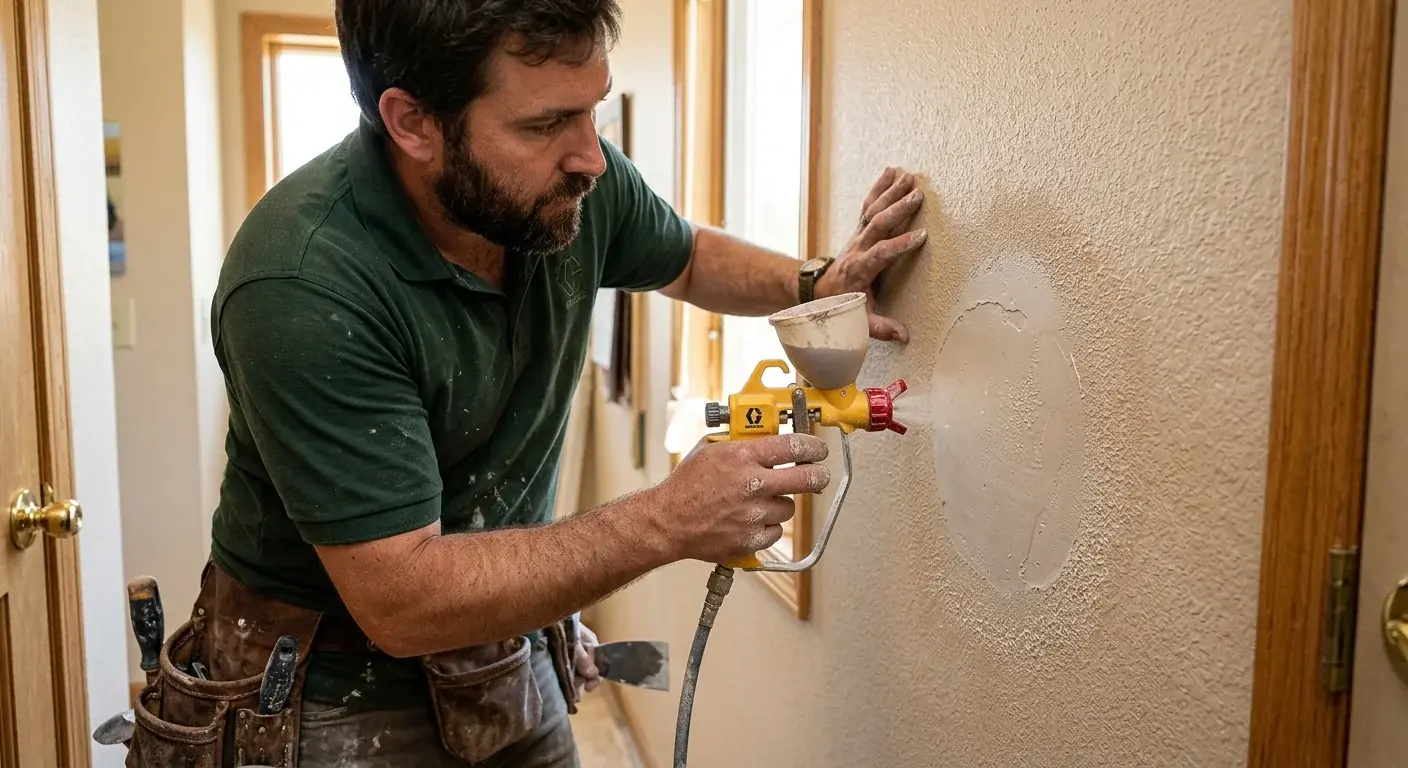
You’ve patched a hole in your drywall and the surrounding wall has a texture. In San Diego homes, blending that texture is a separate scope from the patch. A match is not guaranteed. Ask the independent pro for a test patch and the expected appearance under room lighting.
Why texture matching is the hardest part of drywall repair
Many homeowners can cut, back, tape, and coat a patch. Texture is where DIY work often shows. The pattern, depth, and consistency of orange peel, knockdown, or smooth finish have to be compared to the actual wall, not assumed from the neighborhood or decade.
The matched pro may adjust mix, air pressure, and spray pattern, then feather into the existing finish. That still may not hide the repair. License status for permitted or contracted work can be checked at cslb.ca.gov. For broader drywall scope, see drywall repair services.
Orange peel: how to blend a patch
Orange peel is one texture a pro may encounter in San Diego homes. The property location or construction decade does not establish the finish, so inspect and photograph the actual wall. It gets its name from a dimpled appearance similar to the skin of an orange.
Matching orange peel requires a fine touch. The key is to achieve the right “splatter” size and density.
- Material consistency: The joint compound used needs to be thinned down significantly, often to the consistency of pancake batter or slightly thicker, depending on the desired texture. Too thick, and you’ll get heavy blobs; too thin, and it’ll run.
- Application method: Most pros use a texture sprayer with a fine tip, applying the mixture with quick, overlapping passes. The distance from the wall and the air pressure are critical. Spraying too close creates a heavier texture, while spraying too far results in a finer, more dispersed pattern.
- Feathering: This is the technique of gradually reducing the amount of texture as you move away from the patch. It can reduce a hard transition, but the expected appearance still depends on the aged finish, paint, and lighting. For more context, see how to patch a drywall hole in San Diego.
Knockdown: the two-step process most DIY attempts miss
Knockdown texture is another popular choice in San Diego, particularly in custom homes or those with a slightly more contemporary or Mediterranean feel. It starts similarly to orange peel but involves an extra step that gives it its distinctive flattened, stucco-like appearance. This two-step process is where many DIY projects go wrong.
First, a texture material (usually a slightly thicker mix of joint compound) is sprayed onto the wall, creating raised “stalactites” or blobs. This is often a heavier application than orange peel. The crucial second step, the “knockdown,” happens after the texture has partially dried, but before it’s fully hardened. A wide, flat knife or trowel is then lightly dragged across the surface, flattening the peaks of the wet texture. This creates those characteristic smooth, irregular islands against a slightly textured background.
The timing of the knockdown is everything. If you knock it down too early, the texture will smear or disappear completely. Too late, and it won’t flatten properly, leaving sharp edges or tearing the partially dried material. The angle and pressure of the knockdown knife also significantly impact the final look. Achieving that natural, irregular pattern without distinct trowel marks or visible seams at the patch requires practice and a keen eye. It’s a delicate balance that separates a professional finish from a noticeable repair.
Smooth finish and why it can cost more
A smooth finish can reveal small surface variations under paint and side lighting. Extra joint treatment or a broader skim coat may be proposed. Primer and sheen should follow the selected coating. Higher sheen can reveal variation rather than hide it. If interior painting follows, define that preparation in the quote. Smooth work can take more labor; it is not a promise of a flawless wall.
Aerosol cans vs hopper guns: what a pro uses
When you’re attempting a DIY texture match, you might grab an aerosol texture spray can from the local hardware store. For the smallest patches, these cans can offer a passable solution. They’re convenient, inexpensive, and require no special equipment. However, they come with significant limitations. The spray pattern is often inconsistent, the material tends to clog, and it’s incredibly difficult to match the specific “splatter” size and density of existing wall textures, especially larger patterns like those found in San Diego homes. The resulting texture can look artificial and stand out.
A professional may use a texture hopper gun, another sprayer, or hand tools depending on the pattern, repair size, access, and selected product.
- Hopper gun: This device consists of a hopper that holds the thinned joint compound, which is then fed into a spray gun connected to an air compressor. Pros can adjust the air pressure, nozzle size, and material consistency to precisely control the splatter pattern, from a fine orange peel to a heavier knockdown. This versatility allows them to mimic a wide range of existing textures.
- Consistency and volume: Hopper guns handle larger volumes of material, allowing for consistent application over larger repair areas and ensuring the texture doesn’t change halfway through the job.
- Feathering control: Adjustable spray can reduce a hard edge. It does not make every repair disappear.
While an aerosol might fix a tiny nail hole, anything beyond that demands the precision and power of a professional sprayer to truly blend new work with existing walls. For details on what goes into professional work, check out our insights on drywall repair cost in San Diego.
When a small patch needs a full wall retexture to look right
Older walls can have texture, paint layers, or lighting that a small patch will not hide. The independent pro may recommend retexturing a full wall or room for a more even plane. That is a larger scope and a separate quote, not a promised invisible repair. A skilled assessment still cannot guarantee a perfect result.
When to call
Drywall texture matching can require test applications, specialized tools, and experience. If the repair crosses a prominent finish, ask the independent pro to explain the blend boundary and expected appearance under normal room lighting. Call us at (858) 400-4611 and we’ll match you with a pro who can quote the job after taking a look.
Would you rather hand this one to a pro than do it yourself? Call (858) 400-4611.
Request a quote