A split rail on a Santee backyard fence often shows up as a sag, a popped nail, or a board that no longer sits true. Before you call for fence rail repair santee help, walk the line and write down what you see. Those notes and photos are what a matched local handyman uses to quote the right bay.
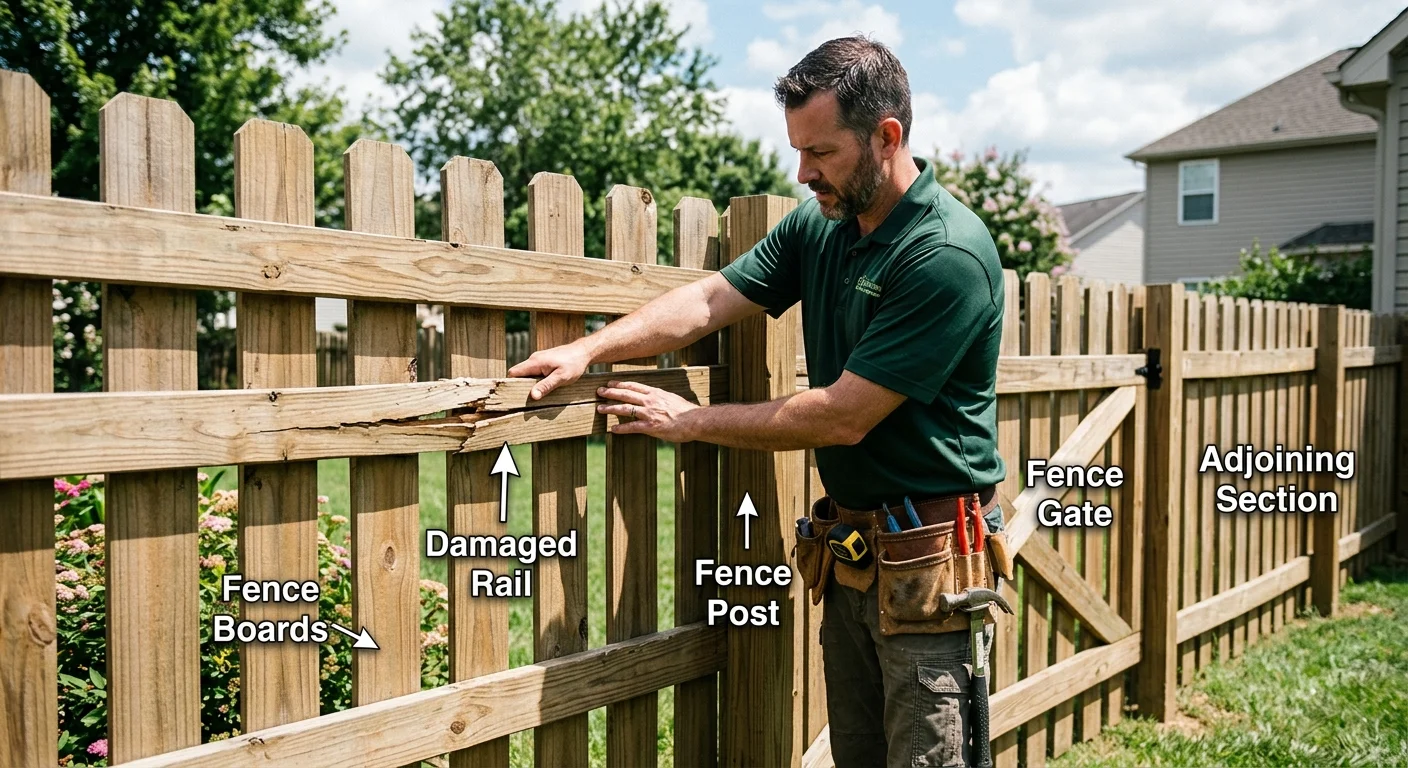
Locate damage along the fence rail
Start at one corner and walk every bay. Inland East County sun cooks west and south faces. A rail that still looks fine from the patio can be split on the neighbor side.
Name the damage in plain words. Split along the grain. Crack at a screw or nail. Rail hanging off a post. Vinyl rail slipped from a bracket. Chain-link top rail bent. Missing chunk. Soft wood at a joint. You are not diagnosing the cause. You are pinning the spot so a pro is not guessing from one cropped photo.
Count bays from a fixed landmark. Third bay left of the side-yard gate, counting from the house, is useful. Somewhere in the back is not. Note whether the failed piece is the top, middle, or bottom rail. On a wood privacy fence those three members take different fasteners and different matching stock. On a ranch-rail run, say which horizontal failed.
Measure what you can without pulling the fence apart. Post-to-post span. Height of the damaged rail from grade. Length of the crack. If the rail has dropped, note the gap in inches at the worst point. A tape against the phone is enough. Write the numbers in the same note as the bay count.
Santee lots are not one shape. Flatter yards near Town Center and along Cuyamaca Street often give you a clear walk. Steeper backyards in Carlton Hills or above Mast Park can hide a failed rail behind ice plant or a retaining edge. Walk both sides of the fence if you can do it without stepping on a neighbor’s planting. If you cannot, photograph through the boards and say the far face was blocked.
Mark the damaged bay with painter’s tape or a clothespin so later photos match. Heat on an inland afternoon can open a hairline that was closed in the morning. If you shot the rail at dusk and it looks worse at noon, shoot it again and keep both. Date the notes. Include the street if the run faces Magnolia Avenue, Prospect Avenue, or another public side.
Look at the fasteners while you are there. A rail can look cracked when the real issue is a pulled nail in a shrinking post. Record the rail and the fastener in the same breath. Fence repair near me messages go farther when the first note already names the bay, the rail, and what moved.
Record connected posts, boards, and gates
A rail does not float. It sits on posts and holds boards, pickets, or mesh. Write what touches the damaged member, even if you only called about the rail.
For each post at the ends of the bay, note whether it stands plumb, whether the top is split, and whether the bracket or dado still holds. Push gently with one hand at chest height. If the post moves, write that it moves. If it does not, write that too. A leaning fence post changes the job even when the homeowner only asked about a horizontal. Capture the post top, the grade line, and the rail end in one frame.
Boards and pickets: count how many are split, missing, or hanging from the failed rail. Note which face they sit on. Three privacy boards gone on the street side is a different photo set than one broken ranch rail in a side yard. For vinyl, note whether a whole panel popped or only the rail insert moved. For chain link, note the top rail, the mesh, and whether tension bars still sit in the end post.
Gates belong in the same record when they share a post with the damaged rail, or sit in the next bay. A gate that now drags or will not latch is part of the rail story. You do not need a full gate diagnosis here. You need the pro to see that the moving part and the rail share wood or vinyl.
Hardware gets a close shot: hinges, latches, rail brackets, lags, nails. Inland heat pulls fasteners. Name the metal if you can see it, galvanized, painted, or rusty. Do not guess a brand. A close photo of the head and the hole is enough.
Shared lines: this page cannot confirm who pays for a shared fence in California. That is a neighbor and title question, not a photo question. Record whether the damaged rail sits on a side or rear line. Confirm ownership before anyone cuts boards that may not be yours.
If the notes start to point at digging around a post, treat excavation as its own step. Request marks through 811 before anyone digs, and wait for the responses. Fence-post holes are included in that request. Marks do not show every private line on the lot. A call alone does not authorize digging.
Compare one section with neighboring sections
Stand back and look at three bays: the damaged one and one on each side. A single cracked rail on an otherwise tight run is one kind of quote. A cracked rail in a stretch where every board is cupping is another.
Write what is different. Color. Warp. Fastener rust. Rail height. Gap at the post. If the neighboring rails already sag, a one-rail swap may not match for long. Put that comparison in the notes you send. Use our fence repair versus replacement guide when the whole run looks tired, so you are not asking for a rail-only number on a longer failure.
Do not use a percentage you saw online as a cutoff. No verified figure on this site says a fence must come down after a set share of damage. Ask the matched pro to show you what they would keep and what they would cut, bay by bay.
Match matters in Santee because a new rail on a sun-baked privacy fence will read paler than the rest. Photograph a neighboring bay in the same light as the damaged bay. Note stain or paint. If the street face is visible from the sidewalk, write that. Do not invent an HOA rule. Attach the actual guideline if you have a PDF or a handbook page.
Wind and slope are site facts, not a diagnosis. East County gusts hit a privacy fence like a sail. If the failed rail is on a ridge lot or a downhill run off Carlton Hills, say so. If irrigation overspray hits one face every morning, say so. Walk the inside and the outside. A rail can be cracked on the neighbor side and painted over on yours. The comparison set should show both faces when access allows.
Take one photo from far enough back that a person can count bays without you explaining. Then take the close set. The far shot is how a handyman santee homeowner keeps the broken piece in context.
Document materials, finish, and property access
Name the material in the notes: wood privacy, wood ranch rail, vinyl, chain link, or mixed. If you do not know the species or the vinyl product line, do not guess. Photograph the profile instead. End grain, cap, and the way the rail meets the post tell a pro more than a brand you are unsure of. A mixed run, wood next to chain link along a side yard, needs both materials in the album.
Finish: bare, stained, painted, or factory vinyl. If paint is peeling, include a close shot. Whether older fence paint contains lead, and what rules apply if that paint is disturbed, could not be confirmed from the facts approved for this page. Put the house year in the notes if you know it, and let the matched pro speak to how they will handle the paint before anyone sands or scrapes.
Access is the part Santee homeowners skip. Write how a person carries a new rail from the street to the bay. Side-yard gate width. Locked dog run. Slope. Low patio roof. Pool equipment crowding the line. Cars that block the driveway on a weekday. If the only carry is a long walk from a Mission Gorge Road approach, write that. If the rear yard backs toward SR 52 and there is no rear gate, write that a truck cannot stage behind the fence.
Deck and fence repair jobs in this county often stall on access, not on the rail itself. A driveway photo and nothing else produces a vague reply. Gate width, slope, and where a board can be set down produce a scoped quote.
Permits: whether the City of Santee requires a permit for replacing one rail could not be confirmed from the facts approved for this page. Check with the city before anyone starts. California requires a licensed contractor for work that needs a permit, and for projects where labor, materials, and all other items total $1,000 or more, unless a narrow minor-work exemption applies. That exemption is only for casual, minor work that needs no permit. It does not cover work that is part of a larger job, split contracts, advertising as a contractor, or hiring others to do the work. Verify a license on the CSLB license check before you sign.
Send wide and close photographs for review
Send both distances. A wide shot from the patio that shows the house, the damaged bay, and two neighboring bays. A second wide shot from the other side of the fence if you can stand there. Then close shots: the crack, the fastener, the post top, the rail end in the post, and any failed board hanging from that rail.
Shoot in daylight. East County noon glare washes out splits. Mid-morning or late afternoon on the shaded face is clearer. Include a tape or a coin in one close shot for scale. Do not add filters. Do not crop out the posts.
On the phone, make a short album: wide, close, neighbor bay, access path, and the gate if it shares a post. Caption each with the bay count you used in the notes. Bay 3, top rail, house side is enough. If you already searched fence repair near me and plan to call, put the Santee street, the material, the bay count, and the access note in the first message.
Fix Pro San Diego is a referral service. It matches you with licensed independent local pros. It does not repair fences, own trucks, or set prices. The pro you are matched with reviews the photos, confirms the scope on site, and quotes you directly. Ask that the quote list what stays and what gets replaced. A rail-only number that ignores a moving post is not a complete scope. Keep the photos. They are the record if the job grows once the rail comes off.
No published, verified price for Santee fence rail repair is on file for this page. Ignore round numbers on national listing sites. The total is labor, materials, haul-off, match work, and access. Get it in writing, with every item in one figure, before anyone cuts a board.
When to call us
Call when the rail is split, hanging, or pulling a gate out of line, and you want a matched local pro to quote from real photos instead of a guess. If the post moves, the run looks tired on both sides, or you cannot reach the bay without a long carry, hand the visit to a pro rather than forcing a one-rail fix yourself. Call us at (858) 400-4611 and we’ll match you with a local pro who quotes the job before starting.
Would you rather hand this one to a pro than do it yourself? Call (858) 400-4611.
Request a quote