A wobbly fan that just needs a blade balance kit is a different job from a dead motor or failed capacitor that requires opening the housing. Here’s how to figure out what you’re dealing with.
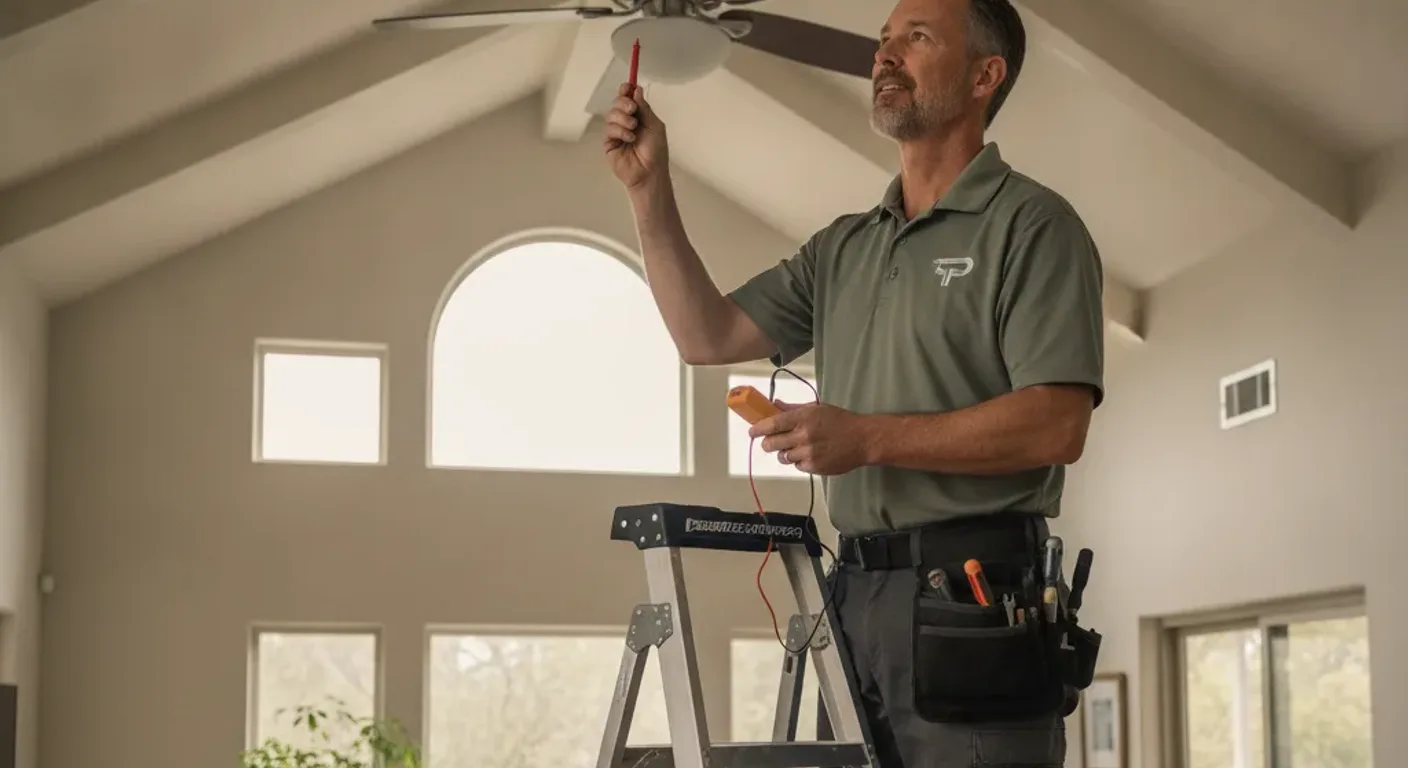
The most common ceiling fan problems in San Diego homes
Fan condition, installation location, exposure rating, access, and model-specific parts determine the repair scope. Do not infer the fault from a neighborhood or the age of the home.
Here are the problems a handyman sees most:
Wobble. Turn the fan off and check the manufacturer’s troubleshooting steps. Loose hardware, damaged blades, installation, or balance can each be involved; stop using a fan that moves at the ceiling connection.
Noise. Humming points to a failing capacitor or an incorrect dimmer switch (standard dimmers fight fan motors). Clicking or rattling often means loose screws on the blade brackets or light kit. Grinding suggests worn bearings in the motor.
Fan completely dead. Turn the fan off at the breaker and have a qualified professional diagnose the switch, supply, receiver, or internal components.
Pull chain broken. The chain pulls free of the switch housing inside the fan. A handyman opens the canopy, replaces the speed-switch assembly, and reattaches the chain. It’s a common repair on older fans.
Remote or wall control not working. The receiver inside the fan canopy can fail, or the frequency can conflict with another device in the house.
Light kit out but fan runs. Usually a failed capacitor on the light circuit, a dead socket, or a burned bulb socket. Sometimes the light-limiting switch (a small device in some fans that prevents bulbs over a certain wattage) trips and needs replacing.
Repair costs by scenario
Pricing depends on the product, access, mounting surface, existing connections, and any work the professional excludes from the quoted scope. Ask for a written quote after the pro reviews photos and product details.
A like-for-like fan swap is a replacement job. Compare that scope with the ceiling fan installation cost guide. If the new fan is going somewhere it’s never been before, that’s a different project covered in the ceiling fan installation guide.
Repair vs. replace: how to make the call
Compare a written repair quote with the price and warranty of a compatible replacement. Age alone does not decide whether a fan is repairable.
A few rules of thumb:
If the repair cost is more than 50% of what a comparable replacement fan costs, replace it. If the fan is cosmetically outdated and you’ve been meaning to swap it anyway, a repair gives you functional life but not satisfaction. If it’s a quality fan from Hunter, Casablanca, or Minka-Aire and the motor itself is still sound, almost any repair is worth it, because those motors last decades.
One thing worth knowing: patio fans in coastal San Diego corrode from the outside in. The blades, brackets, and finish go first. But the motor often stays healthy. Cleaning corroded brackets and swapping weathered blades can bring a good patio fan back for much less than replacing it.
What a handyman can fix vs. when you need an electrician
Repairing an existing fan and swapping in a like-for-like replacement is squarely handyman work. What falls outside that scope:
- Running a new circuit from the electrical panel to a ceiling fan location
- Installing a new wall switch in a location where no switch leg exists (requires fishing wire through walls)
- Diagnosing flickering or tripping that points to a panel problem or damaged wiring in the wall
For those jobs, you’ll need a licensed electrician. A handyman who’s honest about scope will tell you this upfront. Fix Pro San Diego is a referral service and does not complete the work.
If you also want related electrical work quoted, the independent pro can separate it: swapping a standard switch for a ceiling fan speed control, replacing a fan-only fixture with one that includes a light kit, or upgrading to a new fan with a remote. That work may be quoted under light fixture or general repairs depending on the scope.
Frequently asked questions
How much does it cost to repair a ceiling fan in San Diego?
Simple fixes like tightening loose hardware or installing a balancing kit take less labor. Replacing a capacitor, pull-chain switch, or remote receiver takes more time because the motor housing has to be opened.
Can a handyman fix a ceiling fan, or do I need an electrician?
ESFI strongly recommends hiring a qualified, licensed electrician to perform any electrical work in your home. Ask the professional to separate non-electrical inspection from any wiring, switch, receiver, capacitor, motor, box, or circuit work.
Why does my ceiling fan wobble?
Several faults can cause wobble. Turn the fan off, inspect it only as the manufacturer directs, and stop using it if the ceiling connection moves or parts appear damaged.
Why is my ceiling fan humming?
Humming can have more than one cause. Do not open the housing or handle internal wiring unless qualified; use the manufacturer’s troubleshooting steps or a qualified electrician.
Should I repair or replace a ceiling fan that stops working?
Compare the diagnosed fault, parts availability, warranty, and written repair quote with a compatible replacement.
How long does a ceiling fan repair take?
Capacitor and switch replacements are on the longer end because the motor housing has to be opened and the wiring disconnected safely. Blade balancing and hardware tightening are quick. High-ceiling jobs add time for setup and safe ladder work.
Ready for a quote
If your ceiling fan is wobbling, humming, dead, or acting up, call (858) 400-4611 and we’ll match you with a pro who can quote the job.
Would you rather hand this one to a pro than do it yourself? Call (858) 400-4611.
Request a quote