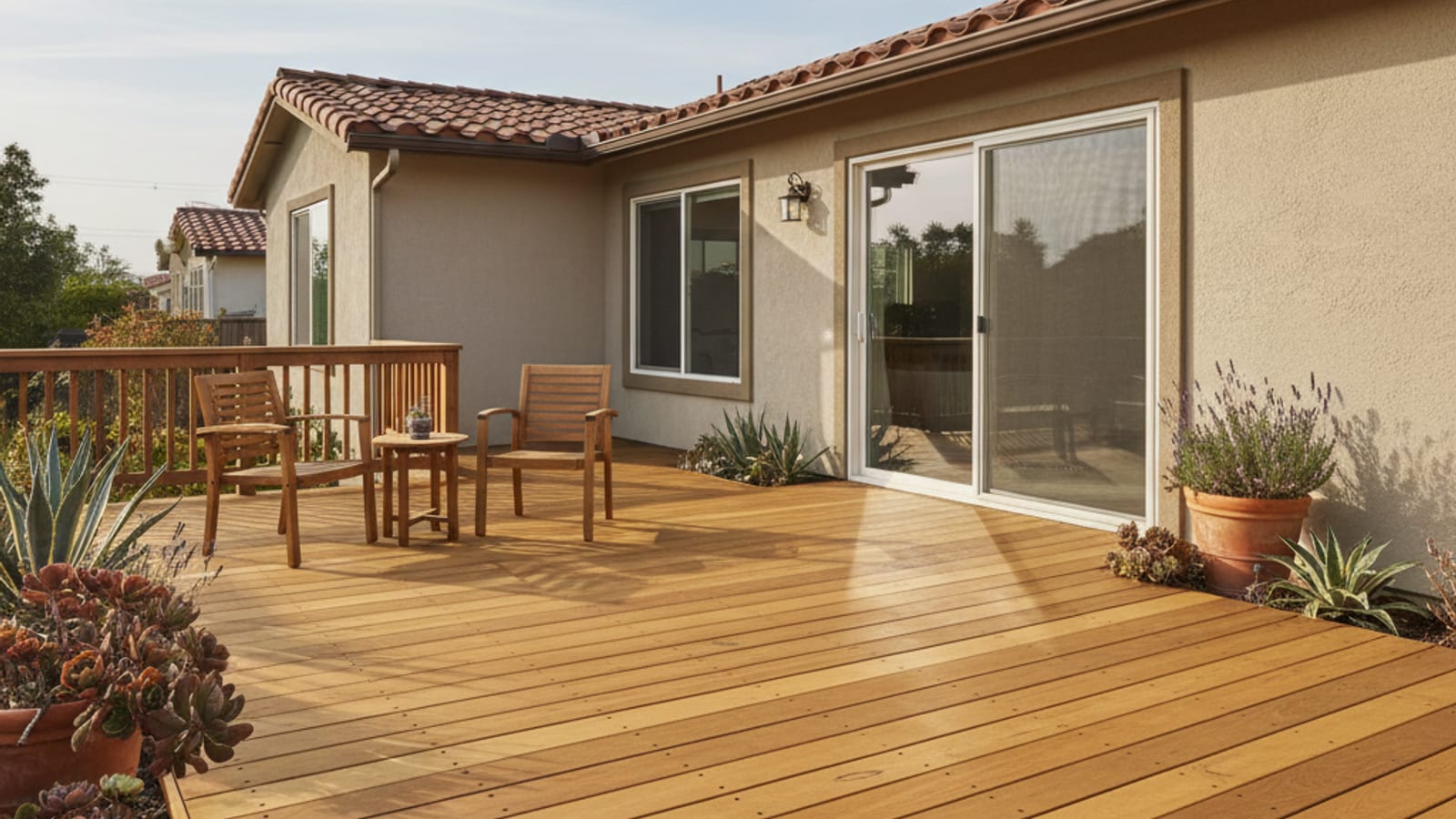
San Diego is one of the best places in the country to have an outdoor deck. You can use it year-round. But that year-round exposure is also why San Diego decks deteriorate faster than decks in climates with defined wet and dry seasons. The combination of intense UV, coastal salt air, and winter rain cycles that wet and then dry the wood creates specific wear patterns that homeowners in other regions don’t deal with as much.
Here’s how to stay ahead of it.
Annual deck inspection checklist
Walk the deck after the winter rain season and before heavy use. How long that pass takes depends on the size of the deck. It is not a timed 30-minute Fix Pro inspection.
Check the surface boards:
- Walk every board and press down firmly. Any board that flexes more than a quarter inch under foot is suspect.
- Look for soft spots with a screwdriver, press the tip into the wood grain. If it penetrates more than a few millimeters with hand pressure only, the wood has begun to rot from the inside.
- Look for raised nail heads or popped screws. These are a tripping hazard and indicate the board has swelled and moved.
- Check end grain on board ends, this is where rot begins. Any darkening or softness at the ends means the board is compromised.
Check the structure:
- Look at the ledger board, the piece that connects the deck to the house. This is the most common failure point. Water gets trapped between the ledger and the house wall, rots the ledger, and eventually the entire deck becomes unsafe. There should be flashing between the ledger and the wall, and the gap should be sealed.
- Check the posts and footings. Concrete footings should be intact with no visible cracking. Posts should be solid, no movement when you push them.
- Look at the beam-to-post connections. Hardware should be present and rust-free.
Check the railings:
- Grab every railing post and push sideways with body weight. Any rocking indicates the post base has failed.
- Check balusters. Local code, not this page, sets the gap limit for a given deck.
Signs of rot: what to look for
Rot doesn’t always look like what you’d expect. It’s not always black or visibly punky.
Early rot looks like discoloration, gray, brown, or slightly lighter than surrounding wood. It feels soft rather than hard when pressed. It may crumble rather than chip.
On San Diego decks, rot most commonly appears at:
- Board ends that are close to the ground or to planter soil
- Areas that stay shaded and don’t dry quickly (under furniture, in corners)
- Any spot where water pools (a slightly concave board, a low spot near a drainage channel)
- Around screws and nails, where the wood-fastener interface traps moisture
A screwdriver test at these locations can show softness. It does not replace an on-site inspection.
Staining vs. sealing: what’s the difference and which do you need
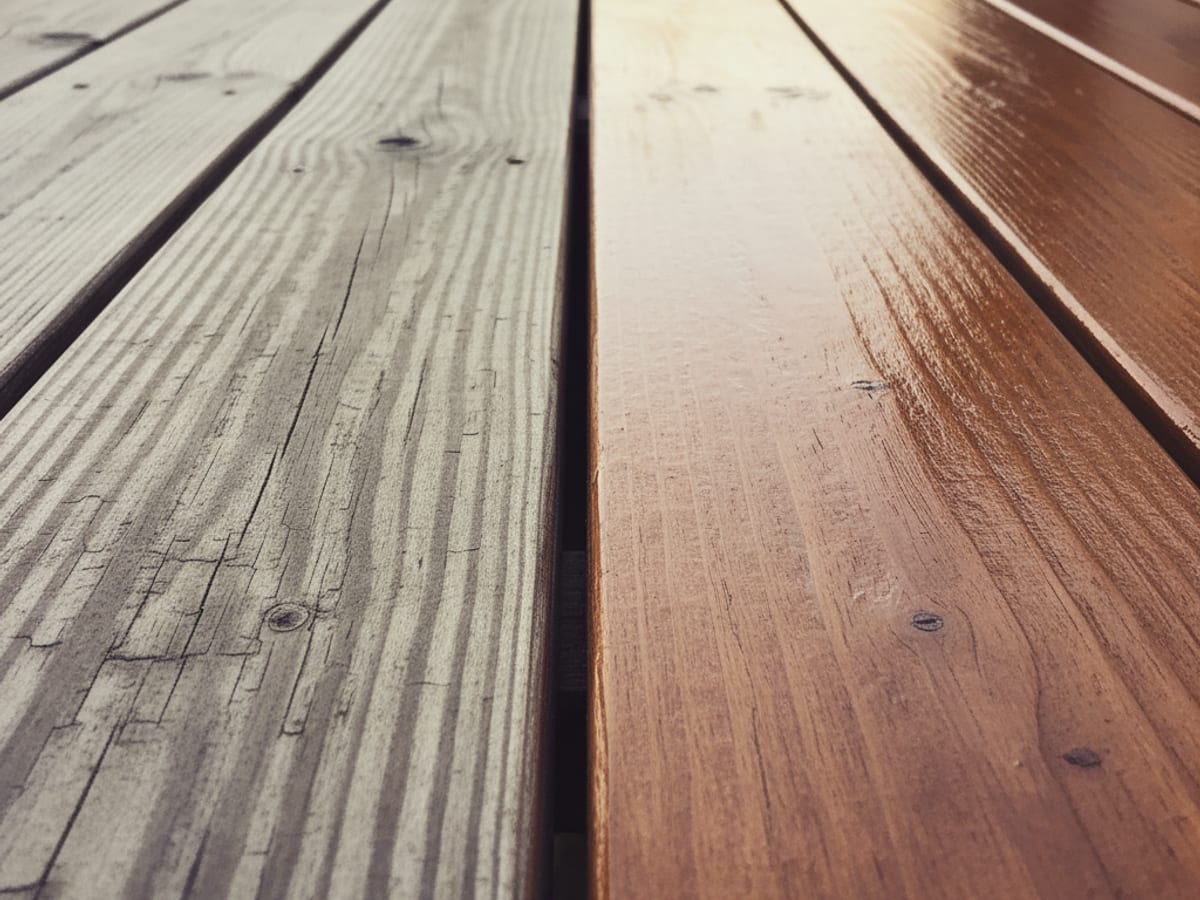
Sealer, a clear or lightly tinted product that penetrates the wood and repels water. It preserves the wood’s natural color and grain. Sealers need to be reapplied every 1–2 years for best protection, more frequently in direct sun.
Stain, contains both water repellent and pigment. Semi-transparent stains add color while showing grain. Solid stains cover the grain entirely (more like paint). Stains last longer than clear sealers, typically 3–5 years for semi-transparent and 4–7 for solid, but solid stains can peel and require more work to reapply later.
For San Diego decks in direct sun: a semi-transparent oil-based stain gives the best UV protection while allowing the wood to breathe. Fully film-forming products (like solid stains or deck paints) can trap moisture on coastal decks and peel prematurely.
The key prep step regardless of product: the deck must be clean and dry before application. Power wash with a deck cleaner, let it dry for 48–72 hours (longer in marine layer weather), then apply. Stain applied over dirty or damp wood will peel within a season.
Tip: In San Diego’s direct sun, a semi-transparent stain with UV inhibitors will outlast a clear sealer by 2–3 years. The extra cost is worth it on south-facing decks.
Permit questions for deck work
Maintenance, board swaps, and structural changes are different tickets. Confirm the current requirement with the building department that serves the address. City of San Diego properties can start with Development Services. Other cities and unincorporated county areas set their own rules. An HOA architectural review is a separate process from a building permit.
Fix Pro San Diego is a referral service. It matches homeowners with licensed, independent local professionals for deck repair. It does not inspect, stain, or rebuild decks. Call (858) 400-4611. The matched professional quotes the work.
Would you rather hand this one to a pro than do it yourself? Call (858) 400-4611.
Request a quote