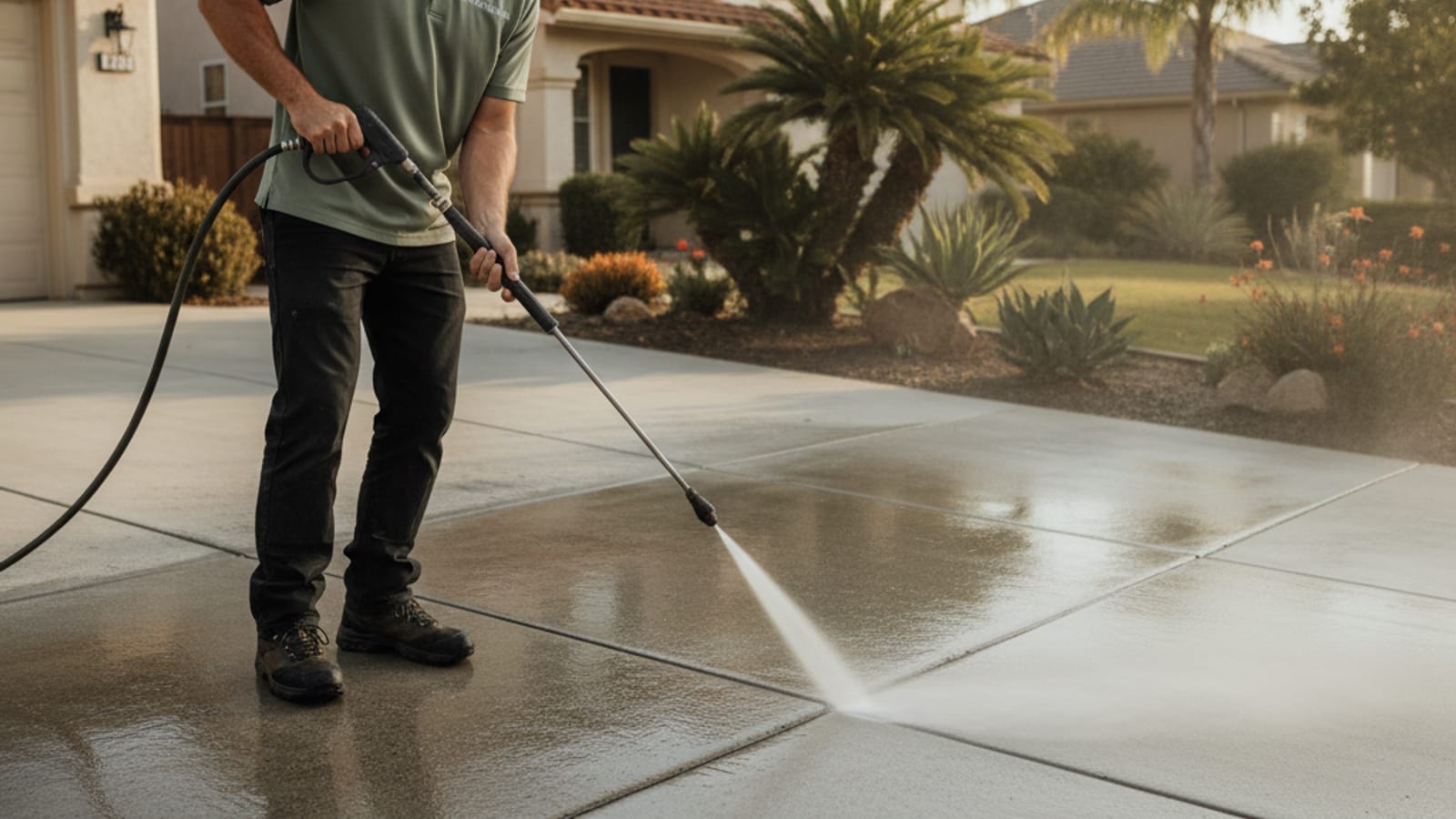
A pressure washer looks like the answer to everything, grime on the driveway, moss on the patio, mildew on the fence, bird droppings on the patio cover. For many surfaces, it is. But in San Diego, where stucco exteriors and cedar or redwood fences are common, the wrong PSI or technique can cause damage that’s expensive to fix.
Here’s how to think through it.
What pressure washing actually does
A pressure washer delivers water at high velocity. The cleaning comes from mechanical force, not chemicals, not scrubbing, and that force is adjustable by changing the nozzle tip, the distance from the surface, and the machine’s pressure setting.
Most residential electric pressure washers run 1,600–2,000 PSI. Gas machines run 2,500–4,000+ PSI. Higher isn’t always better, it depends entirely on what you’re cleaning.
Surface-by-surface PSI guide
Concrete driveways and paths: 2,500–3,500 PSI Concrete is the most forgiving surface for pressure washing. High pressure cleans oil stains, tire marks, and algae. A 25-degree nozzle works well for general cleaning; a rotary surface cleaner attachment provides even coverage without the streaks that a wand leaves behind.
Concrete block or pavers: 1,800–2,500 PSI Lower than solid poured concrete, because the mortar joints are softer. Too much pressure erodes the jointing material. Direct the spray along the surface, not into the joints.
Wood decks: 500–1,200 PSI Wood is the surface most commonly damaged by pressure washing. The wood grain opens under pressure and can raise, splinter, or etch if the PSI is too high or the tip is held too close. Use a 40-degree wide-angle nozzle, keep the wand moving steadily, and stay at least 12 inches from the surface. Always spray with the grain, not across it.
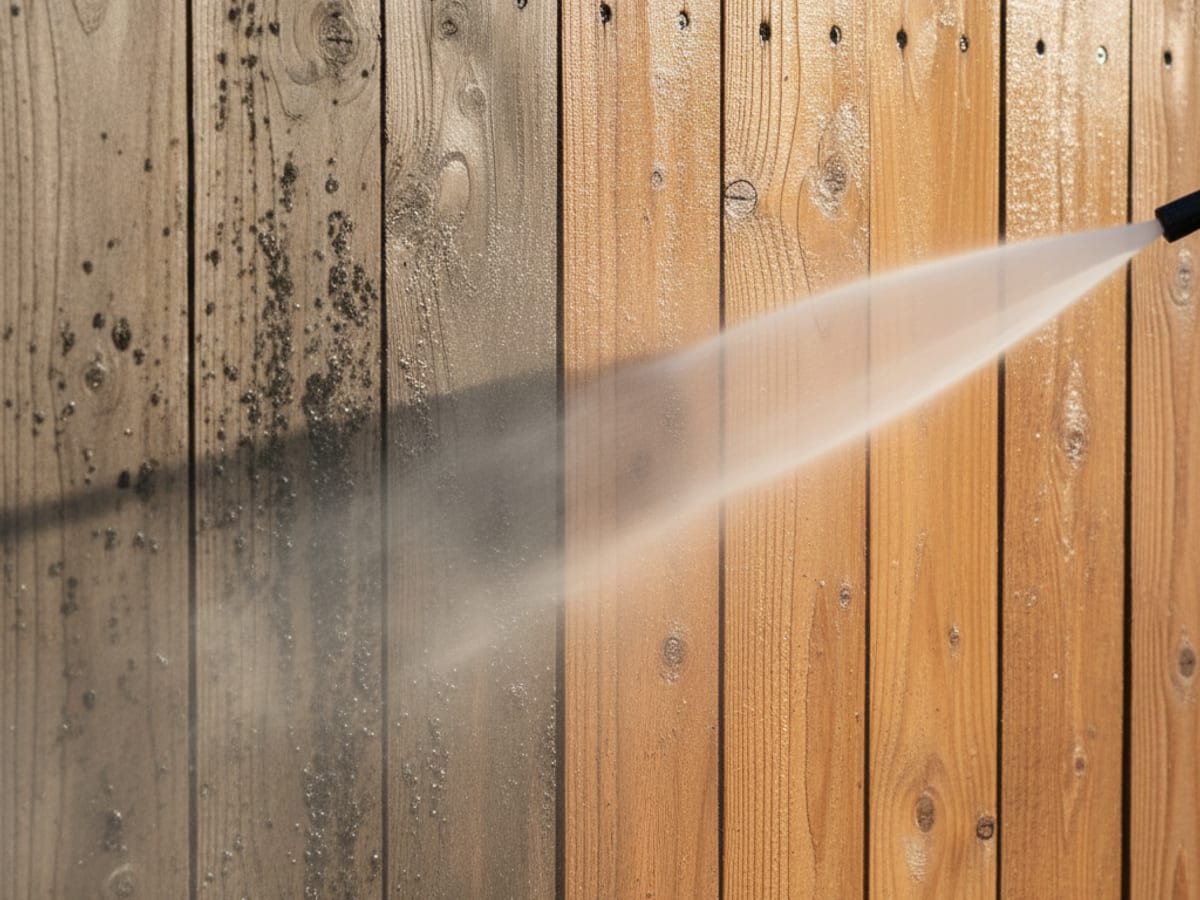
Wood fences: 500–1,000 PSI Same rules as decks. Cedar and redwood, both common in San Diego, are relatively soft and open up readily under pressure. A pressure-washed wood fence should dry for 48 hours before staining or sealing.
Stucco: 1,200–1,500 PSI, max This is where San Diego homeowners need to be most careful. Stucco is a cement-based coating, and while it can tolerate some pressure washing, it’s not as forgiving as it looks. Old or previously repaired stucco may have micro-cracks or soft spots that let high-pressure water work behind the surface. A good rule: use the minimum pressure needed to move the dirt, with a 40-degree tip, at a 45-degree angle to the wall rather than perpendicular. Never power-wash original unpainted stucco at above 1,500 PSI.
Painted siding: 1,200–1,800 PSI Enough to clean without stripping paint. Test a small area first, if paint lifts or bubbles, the paint adhesion is already failing and pressure washing will accelerate the peeling.
The DIY limitations in San Diego
Stucco rooflines and gable ends, reaching the upper stucco surfaces of a two-story home requires either a long lance extension or working from a ladder while managing the kickback force of a running pressure washer. This is a real safety risk. Working from a ladder with a high-pressure machine is a common way to fall.
Roof washing, tile and composition roofs in San Diego develop algae and lichen from the coastal humidity. Pressure washing a tile roof without specific technique training damages the tiles and voids underlayment warranties. Soft washing (low-pressure with a biocide solution) is the correct method for roofs. This is not a DIY job.
Hard-to-reach second-story surfaces, any surface above approximately 12 feet is a hire-out. The equipment plus the ladder positioning plus the pressure kickback creates a risk that isn’t worth managing on a DIY basis.
Tip: After pressure washing a concrete driveway, seal it while it’s clean, a concrete sealer costs $40–$80 for a two-car driveway and extends the time before you need to wash again by 2–3 years.
Safety basics before you start
Eye protection, not optional. High-pressure water and deflected debris at 3,000 PSI is a serious eye hazard.
Closed-toe shoes, never operate a pressure washer in flip-flops or bare feet. This is a real emergency room scenario.
Keep people and pets clear, the working radius around you should be clear. Kids are attracted to the spray; keep them inside.
Don’t aim at yourself or others, even a 500 PSI electric machine can break skin and cause injection injuries.
Test before committing, always test a new surface type in an inconspicuous spot at lower pressure before doing the whole surface.
Fix Pro San Diego is a referral service. Independent local professionals quote pressure washing as a standalone visit or with deck staining, fence repair, or exterior paint prep. For surfaces you are not sure about, stucco, wood, or anything above the first floor, call (858) 400-4611. The matched professional looks at the surface before quoting.
Would you rather hand this one to a pro than do it yourself? Call (858) 400-4611.
Request a quote