A wall-by-wall measurement is what turns a search for baseboard installation near me into a quote a San Diego carpenter can stand behind. A Chula Vista living room with two sliders is a different layout than a North Park bungalow with five door casings and plaster that isn’t square. Bring those numbers and photos, and the pro you get matched with can price the carpentry and trim work from the actual rooms.
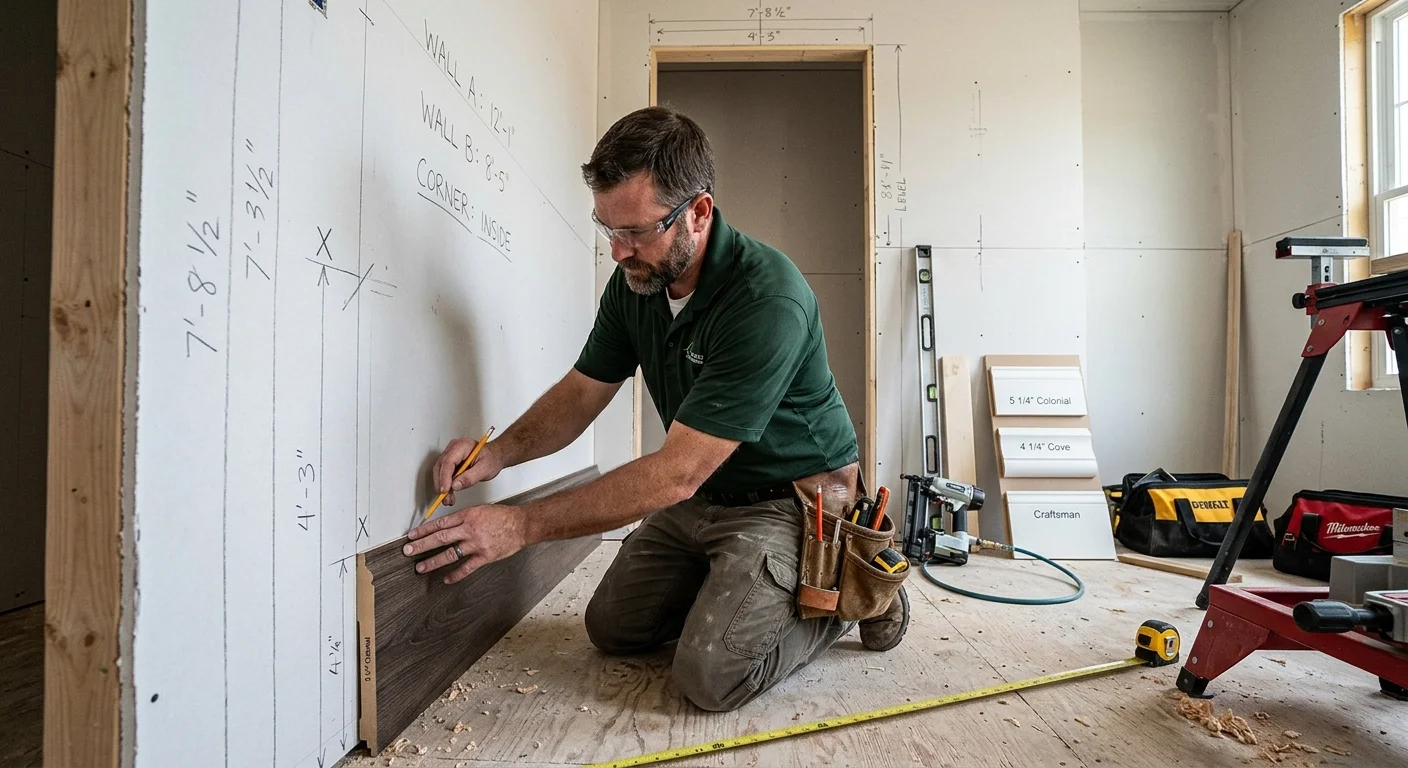
Measure each wall, door, and inside corner
Start at one corner and walk the room clockwise. Write each wall on a sketch. Do not write one room total. Measure along the floor line, where the board will sit. Walls bow. A tape at chair height can be an inch off from the base, especially in older plaster in Mission Hills, Golden Hill, and parts of Point Loma.
Call out every inside corner and every outside corner. Outside corners show up on chimney chases, half walls, and kitchen peninsulas in Clairemont and Kearny Mesa ranches. Each outside corner is two miter cuts. Skip it on the sketch and the footage looks short.
Doors are not open wall. Measure to the casing, then note how wide that casing is. Baseboard usually dies into the casing, so that run is shorter than the raw wall. Sliding doors in Mission Beach, Pacific Beach, and South Bay condos often stop at a track or a jamb. Measure that stop. Don’t treat it like a swing door.
Short returns matter. A stub wall next to a closet in Rancho Bernardo or Carmel Valley can be eight inches of board and two finished ends. Those pieces take time even when they barely add footage. Hallways in Escondido and Vista tract homes are full of those stubs.
Stairs get their own line. A split-level in Tierrasanta or a two-story in Scripps Ranch is not a flat rectangle. Note the starting wall, the landings, and whether the skirt board is in scope.
Add the wall lengths after the sketch is done. Then ask the carpenter whether they want you to buy stock or they will. Don’t pad the number with a made-up waste percent. The person cutting the copes and miters knows how much extra that profile needs.
If you are requesting install in more than one room, keep a page per room. Mixing the dining room with the hallway is how a matching profile gets ordered short. Oceanside open plans and downtown condos fail in opposite ways: long runs versus many tiny returns. Measure both as they actually are.
Record height, profile, and finish
Hold the tape from the finished floor to the top of the existing base. Write the height in inches, not “looks like three.” A 3-1/4 inch ranch profile and a 5-1/4 inch colonial are different boards. Mixing them in one sightline looks unfinished.
Profile is the shape of the face. Photograph a clean stretch. Then photograph a cut end in a closet if you can get to one. A paper tracing helps when paint has filled the details. North Park, South Park, and Golden Hill Craftsman houses often have taller, more detailed stock than a 1990s Otay Mesa or Eastlake tract. Encinitas and Solana Beach remodels sometimes already jumped to a square, modern face. Match the rooms that share a doorway first.
Some designers talk about sizing trim as a share of wall height, sometimes nicknamed a 7 percent rule. That is a design conversation. It is not a San Diego building rule we could confirm in code. Nothing in the city’s permit bulletins or the contractor board sets a legal baseboard height. What usually looks right is matching the door casing already in the room, then staying consistent down the hall. An eight-foot ceiling in Linda Vista and a two-story foyer in Fairbanks Ranch will not want the same visual weight. Let the carpenter see both.
Finish is paint-grade or stain-grade. Write which you have. Painted pine and MDF show up in a lot of newer county tracts. Stained oak shows up in older East County work and some custom rooms. If you want the new board painted, say the sheen and whether the walls stay the current color. Paint is a separate pass from the nail-and-cope work.
If one run is beat up and you are unsure whether to keep the profile, read baseboard damage, repair or replace before you order a whole-house match. Replacing only the ugly stretches only works if the store still sells that exact face.
Mark damage, gaps, and floor transitions
Walk the same path with a pencil and painter’s tape. Mark splits, missing chunks, open corners, and sections pulled off the wall. A vacuum nick is a different scope than a board that crumbled when someone tugged it.
Gaps at the floor are their own note. After new tile, LVP, or hardwood, the old base may sit high, or the reveal under it may be uneven. South Bay and inland tract homes often go to tile. Coastal condos often go to LVP. A sunken living room in Scripps Ranch or a step at a hallway in Point Loma is a transition, not a straight run. Write the floor type on each side of every doorway.
Shoe molding and quarter round are not the same piece. If you already have a small bead covering the floor gap, photograph it. The carpenter may keep it, replace it, or skip it if the new base is scribed to the floor. Don’t assume it is included unless you ask.
Also mark HVAC returns at the floor, outlet plates that sit in the base, and any built-in heater covers in older city neighborhoods. Those are cuts, not straight sticks. Closet door tracks and pocket-door jambs belong on the same list.
None of this is a moisture or structural diagnosis. If a board is soft, stained, or crumbling, photograph it and let the pro look. Fix Pro San Diego does not set prices. For how quotes are usually built in the county, see baseboard installation cost in San Diego. Home Depot’s advertised install packages could not be confirmed as a current San Diego figure here. Those in-store offers change. A matched local carpenter prices from your rooms, not from a big-box flyer.
Plan removal of old baseboard separately
Treat take-off as its own line, not a free extra. Boards that have been caulked and painted to the wall for twenty years don’t pop off clean. Nails hide under filler. Drywall paper can tear. The pro should know whether you want the old material hauled out, stacked for reuse, or left for you.
Reuse only if the pieces are long, straight, and the same profile you want. Brittle paint-grade board from a 1970s El Cajon or La Mesa ranch often breaks at the first corner. Don’t count on it going back.
Homes built before 1978 can have lead in old paint. Disturbing that paint is a regulated renovation issue. Read the EPA’s lead renovation, repair, and painting program if your house is in that era. That covers a lot of Clairemont, Serra Mesa, Normal Heights, and older coastal stock. Ask the pro how they handle painted trim removal.
Designated historic resources and historic districts in the City of San Diego can trigger extra review even for work that looks minor. Confirm with Development Services if your property is designated. Unincorporated county and other cities have their own counters. We could not confirm a countywide “no permit” rule for interior baseboard from the verified ledger, so don’t assume the city is silent. Ask before you pull rooms of original trim in a historic house.
If the job’s labor, materials, and everything else will reach $1,000, California contractor licensing rules apply. Business and Professions Code section 7048 sets that threshold, with conditions. Check the person you hire on the CSLB license lookup.
Say whether walls get patched and painted after take-off. Torn paper at the floor line is common. That patch is drywall and paint, not trim, and it should be on the list so the match is right.
Photograph rooms before requesting installation
Photos do more than a phone description. Take a wide shot of each room from the doorway. Then shoot every inside corner, every outside corner, and every door casing where the base will die in. Add one tight shot of the profile. Add one shot of each floor transition.
Put a tape measure in at least one frame so height is readable. Write the room name so it matches the file name. “Hall” and “front” are how Oceanside and La Mesa houses get mixed when two people are quoting.
If you also want crown, that is a ceiling-line job with its own corners. It is not the same cut list as baseboard. A trim carpenter in San Diego can often handle both, but only if you say both are in scope. Don’t treat “can a handyman install crown” as a yes-or-no. The right match depends on the profile, the ceiling, and the rest of the work. List other trim work near me as separate lines: casing, chair rail, and crown each get their own measurements.
Replacing every room is a taste and condition call, not a rule. If the boards are sound and you only hate the dings, repair may be enough. If the profile fights new floors, or pieces are split, replacement is cleaner. Walk that choice with the photos in hand.
Clear the floor a couple of feet where you can. Move chairs. Note the corners you couldn’t empty. When the packet is ready (sketch, heights, profile photos, damage marks, removal notes), request the install. Fix Pro San Diego is a referral service. We match you with a licensed independent local pro. We don’t install the boards, own the saw, or set the price. The carpenter you get matched with quotes the job, then does the work under that agreement.
When to call us
Hand the job to a pro when the corners aren’t square, the profile has to match through several rooms, or the old boards are painted tight to the wall. That match is for licensed independent local carpenters, not a Fix Pro crew. Call us at (858) 400-4611 and we’ll match you with a local pro who quotes the job before starting.
Would you rather hand this one to a pro than do it yourself? Call (858) 400-4611.
Request a quote