A torn screen on a Rancho Peñasquitos patio or shop front is easy to see and easy to mis-describe. Inland North County dust, dry heat, and canyon wind hit mesh, frames, and tracks in different ways. Record each opening before you request business window screen repair in Rancho Peñasquitos.
Identify the screen, frame, and track
Start with the opening, not the hole. A window screen, a sliding patio screen, and a hinged screen door all use mesh, and they still quote as different jobs. In Rancho Peñasquitos you often see all three on one property: bedroom sliders facing Los Peñasquitos Canyon, kitchen windows on the street, and a shop door on Black Mountain Road that takes hands all day.
Name the room or suite. Name which opening. Then name the part.
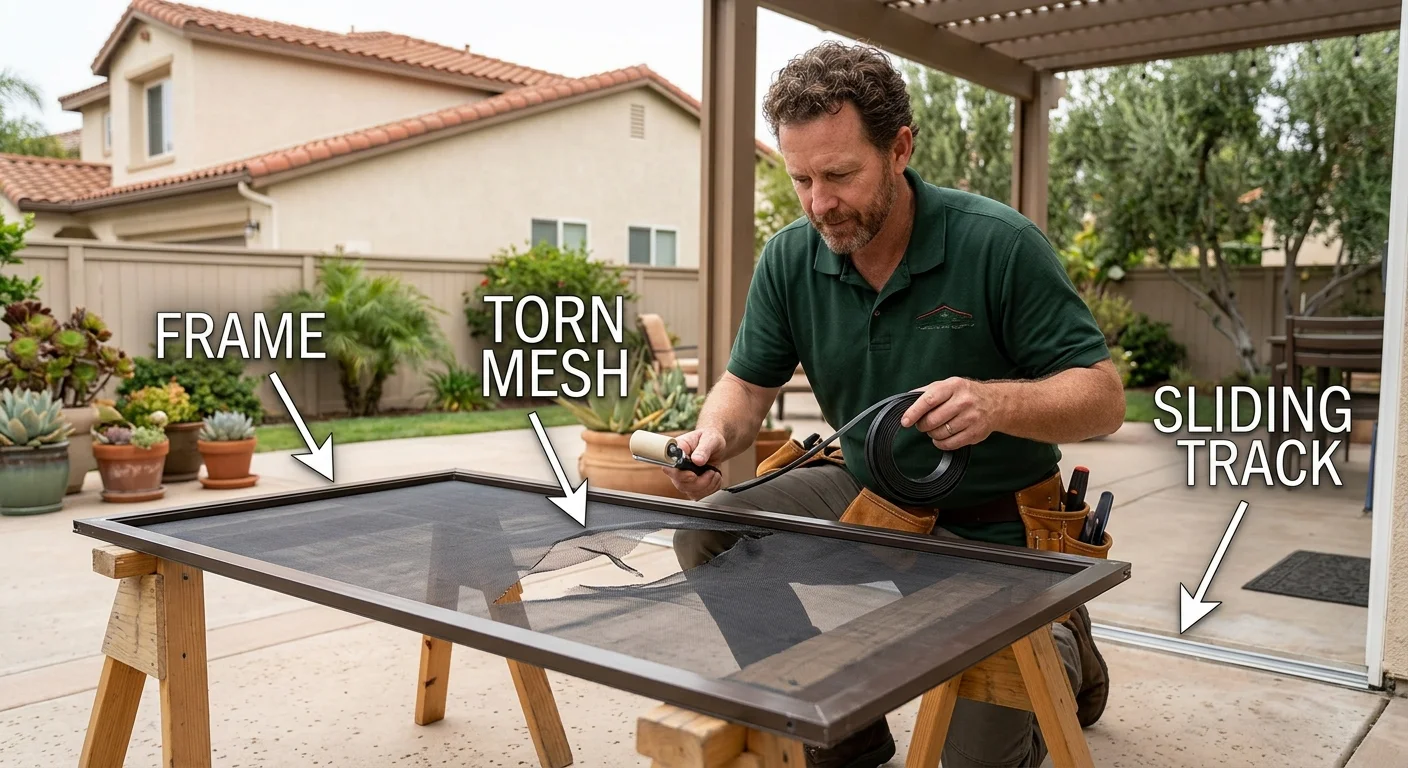
The mesh is the weave. Write the color you see. Note whether it sags, feels brittle, or has pulled out of the spline groove. Do not guess a product name. A close photo of the weave is enough for an independent local pro.
The frame is the rigid border. Note metal only if you can see it. Check all four corners. Look for a split, a crush, or a corner that no longer sits square. A bent frame will not slide after you put new mesh in it.
The track is the channel the screen rides in, or the lip it clips onto. Patio sliders here sit in sun and canyon dust. Grit packs the channel. The screen then scrapes, jumps the rail, or will not latch. A window screen that pops out of a spring clip is a hardware note, not a mesh note.
If the moving panel is a full screen door, say that on its own line. That job can include rollers, a closer, or a latch that a window rescreen never touches. Keep window screens and door screens separate on the list.
For a small business, mark which elevation the public sees. A torn lobby screen and a torn break-room screen are not the same priority. List both anyway. A pro prices travel and setup once, then works a labeled list.
Count the openings and write the number. “Some screens out back” is how a visit gets scoped short, then paused on site. Countywide window screen repair in San Diego searches will not carry this block of notes. Your list will.
Record holes, tears, and hardware trouble
Walk the building once with a notepad. Inland heat makes mesh brittle. Canyon wind then finishes the tear. Pets and kids finish the rest on patio panels.
For each screen, write one line: opening name, hole or tear size (even a rough one), edge or center, hardware yes or no.
A pencil-tip hole at a corner is often spline trouble. A long split down the middle is mesh failure. Several small holes on a rear patio facing the canyon usually mean the panel has sat there a long time. You do not need a cause. You need a count.
Hardware trouble is anything that is not mesh. Missing pulls. Bent latches. Rollers that grind. Springs that no longer hold a window screen in the frame. A shop slider that will not stay closed is a hardware line even if the weave looks fine.
Do not group “all the back windows” unless they truly match. Second-story canyon windows and first-floor street windows age differently. The canyon side takes more wind and more dust. The street side takes more hands from the yard or the parking stall.
On a commercial suite, record occupied hours in the same notebook. That is access, and it belongs next to the damage so the pro can plan. Do not ask Fix Pro San Diego for a clock time. The brand matches you with an independent local pro. That pro sets the visit.
If glass is cracked, fogged, or will not lock, the screen is the wrong ticket. Put that opening on a window list and leave the screen note attached so nothing is dropped.
When you finish the walk you should have three numbers: how many screens, how many frames, how many tracks. Those numbers are what you hand over when you call.
Separate rescreening from frame replacement
Rescreening is new mesh in a sound frame. Frame replacement is a new border, and often new hardware, because the old one will not sit, slide, or hold spline.
Sight for square. Stand at one corner and look at the opposite corner. A parallelogram is a bent frame. New mesh will not pull it true.
Look at the spline groove. If the channel is crushed, the cord will not stay. That is a frame problem.
Look at the meeting rail on a sliding patio screen. If it is twisted, the latch will miss the strike. Mesh will not straighten it.
Look at white powder or pitting on aluminum near irrigation. Some Rancho Peñasquitos lots sit above slopes where spray hits the lower track. Record stain and pitting. Do not diagnose the metal.
A door and window repair visit may be the right match when the sliding glass door itself sticks, the screen is a side issue, and the track is shared. Say that in the notes. Do not assume one trade for glass, screen, and rollers unless you want them scoped together.
Licensing can turn on the whole list, not one panel. California’s Business and Professions Code section 7048 can exempt casual, minor work below $1,000 for labor, materials, and all other items, and only if no permit is required and the other conditions in that section are met. Price alone is not permission. The exemption does not apply when the work is part of a larger operation, split to stay under the line, advertised as contracting, or done with hired employees. The Contractors State License Board tells consumers that licensing is required for projects that need a permit, use employee labor, or cost $1,000 or more. A shop with a dozen openings can cross that line even when each panel looks small. Ask the pro how they license the full list, and check a license before you sign.
The City of San Diego treats some minor repairs under $1,000 as work that does not need a building permit when you replace components with similar materials for maintenance and you do not touch electrical, plumbing, or mechanical systems. That path does not apply on designated historic resources or inside historic districts. Rancho Peñasquitos is a community of the City of San Diego, so Development Services is the office to ask if the job is more than mesh, the opening will change size, or the building has historic review. Confirm that before anyone cuts a new opening. Do not treat a storefront the same as a house without asking.
Note patio, window, and building access
Access is half the job on a canyon lot. Rear patios here often sit above a slope, with stairs, a side gate, and no path for a long frame. Second-story windows may need an interior pull if the screen is meant to come in. Write which way each screen comes out.
For a home, note dogs, kids, and which slider is the daily door. For a shop, note customers, deliveries, and whether the torn screen is the only ventilation in a rear room.
Plaza parking matters. If the unit is in a small center off Carmel Mountain Road or Black Mountain Road, write where a pro can unload a stack of frames without blocking a fire lane. Steep private drives on canyon-edge streets matter more than the freeway. Interstate 15 is the east edge of the community. It rarely changes how you reach a patio unless the suite only has alley access from that side. Put the real constraint on paper: stairs, occupied hours, no elevator, screens that only come out from inside.
Group the work. Ground-floor patio screens on one line. Interior window screens on another. Public-facing shop screens on a third. A commercial handyman visit is often the right match when the occupant is a suite, not a house, and the list mixes screens with other small items.
Do not wait on a clock from the referral line. Fix Pro San Diego matches you with an independent local pro. That pro reads the access notes and tells you what the visit requires.
If a screen sits over a drop into Los Peñasquitos Canyon or a side yard with no footing, write “no exterior footing.” That single line stops a bad plan.
Photograph each screen before requesting repair
Photos keep a six-screen list from turning into a guess. They also keep a shop and a house on the same property from getting mixed together.
Take two shots of every opening. One wide, so the pro sees the window or slider in the wall. One close, so the tear, spline, corner, and latch are readable.
Hold a sheet of paper in the wide shot with the opening name: “Suite 4, rear slider, canyon side.” Phone timestamps help. Names help more.
Shoot the track with the screen half open. Dust, dead insects, and a bent rail show up there. Shoot the four corners. Shoot the latch from the inside.
On a business, photograph only when you already have the right to be there. Daylight on inland stucco is enough. Do not stand in a parking lot after close for a better angle.
Keep the photos in one album, in walking order. Start at the public door and move clockwise. That order is how you will talk through the job.
Then send the list and the album together. “Need window screen repair” is a search. Your packet is the scope: count, mesh vs frame vs track, access, and pictures. If a related door roller or latch belongs on the same visit, say so in the caption and keep that door repair item on the same punch list. One labeled list beats three vague calls.
When to call us
When the list is more than one pop-out window screen, a frame will not sit square, or the building is an occupied shop, hand the packet to a pro. An independent local pro can read your photos and separate mesh-only panels from bent frames. Call us at (858) 400-4611 and we’ll match you with a local pro who quotes the job before starting.
Would you rather hand this one to a pro than do it yourself? Call (858) 400-4611.
Request a quote